The biggest changes in the wireless industry since 2000 have been consolidation among wireless carriers and increased use of wireless services by consumers. Industry consolidation has made it more difficult for small and regional carriers to be competitive. Difficulties for these carriers include securing subscribers, making network investments, and offering the latest wireless phones necessary to compete in this dynamic industry. Nevertheless, consumers have also seen benefits, such as generally lower prices, which are approximately 50 percent less than 1999 prices, and better coverage.
Now, if you are a self-described "consumer advocate," I would hope the bottom line here is pretty straightforward and refreshing: Prices fell by 50% in 10 years. That alone is an amazing success story. But that's not the end of the story. The more important fact is that prices fell by that much while innovation in this sector was also flourishing. Do you remember the phone you carried in your pocket -- if you could fit it in your pocket at all -- ten years ago? It was a pretty rudimentary device. It made calls and... well... it made calls. Now, think about the mini-computer that sits in your pocket right now. Stunning little piece of kit. It can text. It can do email. It can get Internet access. You can Twitter on it. Oh, and you can still make calls on it (but who wants to do that anymore!)
The point is, this is a great American capitalist success story that everyone -- especially "consumer advocates"-- should be celebrating. So, what does Public Knowledge president Gigi Sohn have to say?
"These trends do not bode well for consumers, despite any benefits of the moment," she told Ars Technica.
The August 5th issue of The Economist had a compelling cover story entitled "Leviathan, Inc." in which the author notes "[p]oliticians are reviving the notion that intervening in individual industries and companies can drive growth and create jobs." But direct, long-term government management of companies, corporations or, worst yet, entire industries has proven time and again not to be successful.
Simply put, the head of a company makes decisions to maximize the outcome for that company and its owners or shareholders. Any government employee—even one in a role as acting head of a private company—is legally required to make decisions under a far stricter set of guidelines. Guidelines which force the decisions to be made for what is best not for the business they are charged with operating, but for the country as a whole. This is the case even if the decision made by the bureaucrat will result in a 'net negative' to the company and its owners/shareholders.
The article's anonymous author suggests that instead of "pick[ing] winners and coddl[ing] losers," government should improve the environment for all business by reducing regulations, investing in infrastructure, and "encourage winners to emerge by themselves, for example through the sort of incentive prizes that are growing increasingly popular."
Net Neutrality, Banned Business Models & Price Controls
I continue to be mystified by the contention of some Net neutrality advocates that it is not a form of economic regulation. The reality, of course, is that Net neutrality would ban business models and necessitate price controls. If that ain't regulation, I don't know what is. As Robert Litan and Hal Singer note in their new Harvard Business Review essay, "Why Business Should Oppose Net Neutrality," "Non-discrimination under the FCC's net neutrality proposal means that ISPs cannot offer enhanced services beyond the plain-vanilla access service to content providers at any price." Thus, any type of service prioritization or price discrimination would be prohibited under the FCC's Net neutrality regulatory regime.
As I explained in this earlier essay and in the video below, this would be a disaster for investment, innovation, and consumer welfare. Differentiated and prioritized services and pricing are part of almost every industrial sector in a capitalistic economy, and there's no reason things should it be any different for broadband. As Litan and Singer note, "The concept of premium services and upgrades should be second-nature to businesses. From next-day delivery of packages to airport lounges, businesses value the option of upgrading when necessary. That one customer chooses to purchase the upgrade while the next opts out would never be considered 'discriminatory.'"
And let's not forget, something has to pay for Internet access and investment in new facilities. Differentiated services can help by allowing carriers to price more intensive or specialized users and uses to ensure that carriers don't have to hit everyone - including average household users - with the same bill for service. Why would we want to make that illegal through Net neutrality regulation and the misguided price control schemes of a bygone regulatory era?
CNBC Debate on Net Neutrality Regulation & Pricing Freedom
Today I appeared on CNBC's "Power Lunch" to debate Net neutrality issues and the specific role of pricing in this debate. [video down below] Specifically, the producers wanted to know whether websites should be allowed to pay a higher fee to allow consumers faster access to their sites or should it be equal for every website. The show was partially a response to the rumors that the may be some sort of deal pending between Verizon and Google about prioritized services. On the program, I was up against Craig Aaron of Free Press. During the discussion I made several points, many of which first appeared in my 2005 essay on "The Real Net Neutrality Debate: Pricing Flexibility Versus Pricing Regulation." Here are the key points I tried to get across:
In a free-market economy, companies should be able to freely set prices for goods and services without fear of government price controls.
This isn't about consumers paying more for basic Internet access or having their connections "slowed down"? This is about whether the government will allow some broadband services to be differentiated or specialized for unique needs, such as online gaming, live event telecasts, secure telepresence conferences, telemedicine, etc.
Differentiated and prioritized services and pricing are part of almost every industrial sector in a capitalistic economy. (ex: airlines, package shipping, hotels, amusement parks, grades of gasoline, etc.) Why should it be any different for broadband?
It's always important to remember that there is no such thing as a free lunch. Something has to pay for Internet access. It doesn't just fall like manna from heaven. Differentiated services may help in this regard by allowing carriers to price more intensive or specialized users and uses to ensure that carriers don't have to hit everyone - including average household users - with the same bill for service. Why should the government make that illegal through Net neutrality regulation?
Heavy-handing tech mandates - especially Internet price controls - could have a profoundly deleterious impact on investment, innovation, and competition. After all, there can be no innovation or investment without a company first turning a profit. We don't want to return to the era of rotary-dial regulated monopoly, in which our choices were few and our services were standardized and rudimentary. We should let our current experiment with facilities-based, head-to-head competition continue.
X Prizes: Effectively Producing Technological Innovation
Despite recent setbacks, now that BP's efforts to contain the Gulf oil spill have become more successful, focus is shifting to clean-up efforts. The best way to generate innovative, effective clean-up methods is to offer an X Prize for developing such a solution.
While not finalized yet, this idea is far more likely to yield working results than the 112,000 ideas sent to BP through its own submission process. In BP's case, there is neither an incentive nor a well-framed challenge to interest researchers.
An incentivized competition is, on the other hand, often far superior to traditional research grants and after-the-fact prizes. Breakthroughs in navigation, chemical engineering, aviation and autonomous vehicle navigation have been driven by and, in turn, inspired by competitions like the X Prize.
Send In the Clowns: A Review of Oberholzer-Gee and Stumpf's Copyright and File-Sharing (Part 1)
And where are the clowns?
Quick, send in the clowns…
Don't bother—they're here.
—Judy Collins/Stephen Sondheim, Send in the Clowns
Recently, Nate Anderson of Ars Technica published File-sharing has weakened copyright—and helped society. This story's title summarizes the thesis of a "new" paper by those Grokster-loving, Free-Culture-Movement Professors, Felix Oberholzer-Gee and Coleman Strumpf (collectively, "OGS"). Their "new" paper is entitled File-Sharing and Copyright. Fortunately, their non-sequitur thesis does not follow from their clown-car collection of factual, legal, economic, and historical errors that poses as "scholarship."
I've been wading through the FCC's latest Mobile Wireless Competition Report, and articles about it trying to make sense of what the the agency might be up to on this front. It's hard to get a read on where the agency may be going here. As my PFF colleague Mike Wendy suggested in his post on the FCC's report, "far from press reports which state the FCC clearly determined the market is not 'effectively competitive,' well, that's wrong. In fact, the FCC fails to make any such determination whatsoever." Moreover, just flipping through the charts and tables of the 237-page report, one is struck by how dynamic this marketplace is, and how crazy it would be for the FCC to declare it anything other than effectively competitive and highly innovative.
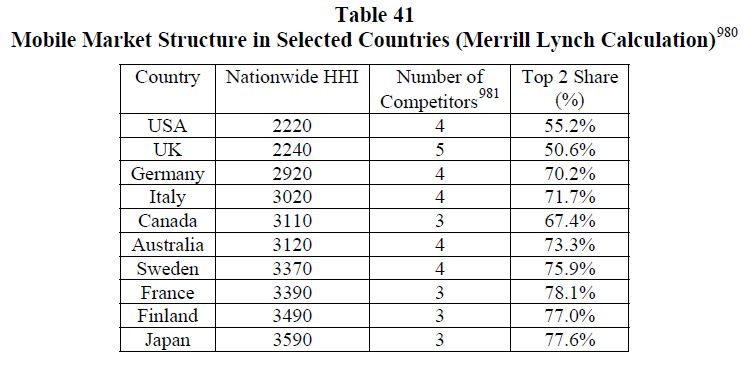
Yet, the FCC and many others seem hung up on industry structure. In particular, there seems to be a lot of hand-wringing about increasing consolidation among the sector's top players. But the data the FCC reproduces in the report seem to undermine that concern. For example, here's a snapshot of the "Mobile Market Structure in Selected Countries," which appears on pg. 197 of the FCC report. It shows how much more consolidated foreign mobile markets are relative to the U.S., which is true of wireline markets too. And you can find much more evidence of how competitive the marketplace is in these two reports.
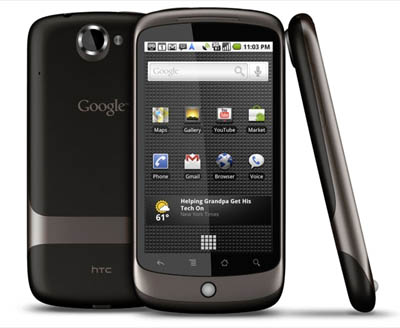
Google has just announced that it is ending web-only sales of its unsubsidized Nexus One smartphone. The company had hoped to created a very different kind of business model for mobile phone retailing, but it just didn't work and so they are ending the experiment.
There are a couple of reasons that it probably didn't work, but the one thing that just about everyone is pointing back to is the difficulty of acclimating Americans to the actual cost of an unsubsidized handset. Over at Ars Technica, Peter Bright points out:
A one-off payment of $529 is hard to stomach. In many countries, we're not accustomed to paying so much for mobile phones, as normally their true cost is hidden--we pay less up front and commit to paying a monthly fee for 12-24 months. Only those brave souls who were willing to stump up for the early termination fee would get any idea of the true cost of their handset. In a world of subsidized handsets, then, the Nexus one felt very expensive. It's true that SIM-only contracts are cheaper than with-handset ones, but the difference rarely feels significant enough to justify buying a full-price phone--much better to pay a little bit more each month and avoid the up-front cost. Even if you do the math and work out that the Google way is cheaper, there's still the unpleasant prospect of spending so much at once.
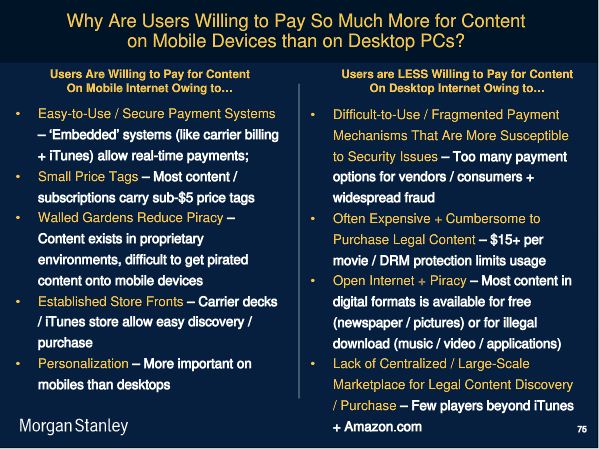
Oh yeah, that was me. And a lot of others. Well, we were wrong. The mobile app store market (Apple, Android, etc) is brimming with a bonanza of micro-business opportunities for producers and consumers alike. I am consistently amazing by the range of offerings available today, the vast majority of which remain free of charge. But what is more impressive is the growing array of applications and games available for mere pennies. Sure, some are more than a buck -- but not that much more. I was just looking through the 40+ apps that I've got on my Droid right now (not really sure how many I've downloaded overall since I've deleted a lot) and I would guess that I paid for at least 25% of them--many after being "upsold" by first trying the free versions and then buying. Yes, I know there continues to be a debate about what counts as a "micropayment," but the fact that so many more people are paying just a couple of bucks or less for content in these mobile app stores suggests that its only going to easier for people to pay even smaller sums for content in coming years.
What got me thinking about all this was slide #75 in Mary Meeker's latest slideshow about Internet trends. The Morgan Stanley web guru notes that users are more willing to pay for content on mobile devices than they are on desktop computers for a number of reasons, but the first of which she listed was: "Easy-to-Use/Secure Payment Systems -- embedded systems like carrier billing and iTunes allow real-time payment." The important point here is that the combination of these slick, well-organized online app stores + secure, super-easy billing systems have combined to overcome the so-called"mental transaction cost problem," at least to some extent. We're not nearly as reluctant today to surf away when something says "$0.99" on our screen. Increasingly, we're hitting the "Buy" button.
Business Insider Attacks James Cameron for "Whining" That Piracy Undermines the Risky Studio Investments That Enabled Cameron's Films To Enrich Millions of Lives
When you read a "business magazine" edited by persons with at least a GRE-level grasp of modern economics, you will not encounter headlines like "Walmart Whines That It Would Be Richer If Poor People Didn't Shoplift," or "DirectTV Whines That Signal Theft Keeps 'The NFL Sunday Ticket' from Raking In More Cash," or even "Capitalist Stooge Steve Jobs Whines That iPod Counterfeiting Keeps Him from Becoming Even Richer."
Predictably, real business magazines and journalists don't publish such quasi-Marxist drool because it is so vacuous. As economist Joseph Schumpeter famously argued, profits enrich particularly thoughtful, creative capitalists because market economies drive producers to innovate. Instead of engaging in a Punch-and-Judy battle to "perfect" competition against non-innovative producers of fungible goods, smart producers can make risky investments in order to innovate and differentiate their products so they can--if consumers really love their work--earn significant profits, (some of which must be re-invested in the next round of risky innovation).
Consequently, real business journalists know that stealing from today's "rich" innovators merely punishes and deters the risky, costly innovation that drives the American economy and creates American jobs. Competent "business magazines" thus reject the economics of dictator Robert Mugabe: they do not smirk and sneer that whenever capitalists innovate successfully and get "rich," then they should not "whine" if others steal from the investors who made the risky investments that let them get rich by innovating.
But Business Insider is not a real business magazine. It has seemingly embraced "Mugabenomics." It appears that Business Insider would thus condemn Steve Jobs if he "whines" about the counterfeiting or shoplifting of iPods. Surely Jobs is now rich enough that stealing from Apple is OK with Business Insider--even though, from the perspective of Apple's investors, the vast sums paid to Jobs are a cost of doing business that reduces their potential profits and their ability to re-invest in more new innovations.
We welcome comments by email - look for a link to the author's email address in the
byline of each post. Please let us know if we may publish your remarks.