|
Tuesday, September 14,
2010
Hubris, Cowardice, File-sharing, and TechDirt
Over at Digital Society, Jim DeLong's Filesharing in Underdeveloped Nations: Let's Take from the Poor and Give to the Rich does a fine job of ripping apart the latest round of nonsense from the economically challenged blog TechDirt. I won't spoil the fun, but suffice it to say that Jim shreds TechDirt "arguments" with casual ease.
Jim's piece also highlights a fundamental problem with TechDirt's childish, copyright-hating worldview: TechDirt brews its venom from an ugly blend of hubris and cowardice.
Continue reading Hubris, Cowardice, File-sharing, and TechDirt . . .
posted by Thomas Sydnor @ 5:11 AM |
Antitrust & Competition Policy, Copyright, IP, Internet, Trademark
Link to this Entry | Printer-Friendly | Email a Comment |Post a Comment (6)
Friday, September 10,
2010
iPhones, DRM, and Doom-Mongers
In the National Law Journal, Dan Brenner's piece, Apps decision: no big deal, provides a thoughtful debunking of the hype that surrounded this summer's decision by the Librarian of Congress to exempt the "jailbreaking" of iPhones from the anti-circumvention provisions of 17 U.S.C. § 1201(a). I tried to make similar points back when the ruling was first issued, but I think that Brenner has better explained the underlying issues.
Continue reading iPhones, DRM, and Doom-Mongers . . .
posted by Thomas Sydnor @ 11:35 AM |
Antitrust & Competition Policy, Copyright, IP, Internet
Link to this Entry | Printer-Friendly | Email a Comment |Post a Comment (12)
Thursday, July 15,
2010
We Need "New York Times Neutrality"--NOT!
I've long been a fan of Danny Sullivan, who edits Search Engine Land, and probably knows more about search engines than anyone outside the companies that actually run them. But my respect for his wit, eloquence and perspective has reached new heights with his latest piece: The New York Times Algorithm & Why It Needs Government Regulation, a lampoon of the NYT's foolish call for search neutrality in an editorial yesterday, turning the Times' arguments right back at them, and pointing out the hypocrisy by which the established press often tries to deny First Amendment protection to newcomers to the speech business. Danny's post is truly a masterpiece of satire, worthy of Jonathan Swift. But one section deserves special attention:
I've been covering the search space closely for nearly 15 years, from before Google itself even existed, so I have seen these types of claims far longer and examined them in far more depth than what went into that New York Times editorial.
My guess is that the editorial staff (the staff that writes the newspaper's editorials, which are opinion pieces, which is confusing when the newspaper also has an editorial staff that writes "editorial" stories elsewhere that are supposed to be unbiased) spent about an hour or so discussing recent Google news, then someone was probably assigned to write the editorial and invested all of about three hours on it.
That's not much time or care for a major and well-respected newspaper (in many quarters) to decide the government should evaluate "fairness" when it comes to making editorial judgments in search results, be they from Google or any other search engine.
I'm afraid Danny's right. What a shameful day for the "Grey Lady." Anyway, here are a few of the pieces Adam and I have written about the dangers inherent in the seductive idea of search neutrality: Continue reading We Need "New York Times Neutrality"--NOT! . . .
posted by Berin Szoka @ 5:37 PM |
Antitrust & Competition Policy
Link to this Entry | Printer-Friendly | Email a Comment |Post a Comment (2)
Thursday, June 24,
2010
Send In the Clowns: A Review of Oberholzer-Gee and Stumpf's Copyright and File-Sharing (Part 1)
And where are the clowns?
Quick, send in the clowns…
Don't bother—they're here.
—Judy Collins/Stephen Sondheim, Send in the Clowns
Recently, Nate Anderson of Ars Technica published File-sharing has weakened copyright—and helped society. This story's title summarizes the thesis of a "new" paper by those Grokster-loving, Free-Culture-Movement Professors, Felix Oberholzer-Gee and Coleman Strumpf (collectively, "OGS"). Their "new" paper is entitled File-Sharing and Copyright. Fortunately, their non-sequitur thesis does not follow from their clown-car collection of factual, legal, economic, and historical errors that poses as "scholarship."
Indeed, I just published a blog post and a longer paper to show that those who listen to the likes of Oberholzer-Gee merely end up accusing the Government Accountability Office of decades of wrongdoing by celebrating the "positive economic effects" of criminal racketeering. The blog post is entitled, Why Copyright Industry Costs-of-Piracy Studies Correctly Ignore the "Positive Economic Effects of Criminal Racketeering; the paper is entitled, Punk'd: GAO Celebrates the "Positive Economic Effects of Counterfeiting and Other Criminal Racketeering.
Continue reading Send In the Clowns: A Review of Oberholzer-Gee and Stumpf's Copyright and File-Sharing (Part 1) . . .
posted by Thomas Sydnor @ 7:46 PM |
Antitrust & Competition Policy, Capitalism, Copyright, Cyber-Security, Economics, Global Innovation, IP, Innovation, Internet, Mass Media, Software
Link to this Entry | Printer-Friendly | Email a Comment |Post a Comment (7)
The FCC Gets Real Schlick
Said FCC Chairman Julius Genachowski on May 6th, "The [Comcast] opinion therefore creates a serious problem that must be solved so that the Commission can implement important, commonsense broadband policies..."
I'll say. It's a problem, alright. Yet the chutzpah of the ensuing NOI process - in particular, the FCC asking whether its Net Neutrality workaround to reclassify the transmission element of broadband as a Title II service is worth doing / can be done - doesn't make it any better. Continue reading The FCC Gets Real Schlick . . .
posted by Mike Wendy @ 3:03 PM |
Antitrust & Competition Policy, Broadband, Capitol Hill, Communications, Internet, Net Neutrality, PFF, The FCC
Link to this Entry | Printer-Friendly | Email a Comment |Post a Comment (3)
Wednesday, June 16,
2010
event transcript: "What Should the Next Communications Act Look Like?"
PFF has just published the transcript for an event we hosted last month asking "What Should the Next Communications Act Look Like?" The event featured (in order of appearance) Link Hoewing of Verizon, Walter McCormick of US Telecom, Peter Pitsch of Intel, Barbara Esbin, Ray Gifford of Wilkinson, Barker, Knauer, and Michael Calabrese of the New America Foundation. It was a terrific discussion and it couldn't have been more timely in light of recent regulatory developments at the FCC. The folks at NextGenWeb were kind enough to make a video of the event and post it online along with a writeup, so I've included that video along with the event transcript down below the fold. Continue reading event transcript: "What Should the Next Communications Act Look Like?" . . .
posted by Adam Thierer @ 6:44 PM |
Antitrust & Competition Policy, Communications, DACA, The FCC
Link to this Entry | Printer-Friendly | Email a Comment |Post a Comment (0)
Sunday, June 6,
2010
Amazing Mobile OS Competition; Can It Last?
Don Kellogg, Senior Manager, Research and Insights/Telecom Practice at The Nielsen Company, has a interesting essay up over at the Nielsen Wire about smartphone competition. ("iPhone vs. Android") It includes some updated quarterly data about the state of the mobile marketplace and, once again, I am just blown away at the continuing degree of operating system (OS)-level competition.
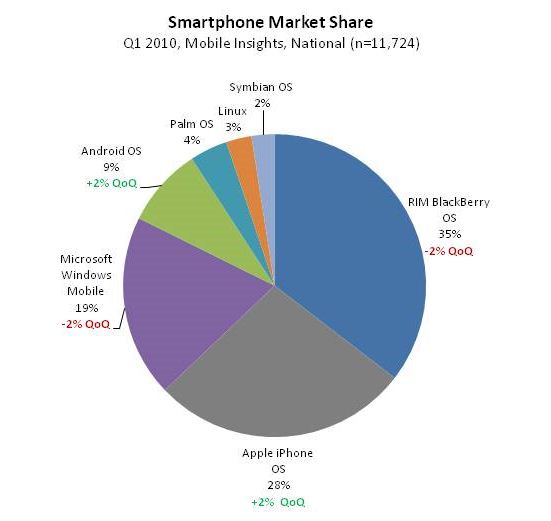 As I have noted here before, this war among Apple, Google, Microsoft, RIM (Blackberry), Palm, Symbian, and others has actually forced me to ask if we have "Too Much Platform Competition" in this arena. App developers must now craft their offerings for so many platforms that it has become a significant developmental hassle and expense. But hey, from a consumer perspective, this is great! (For more details, see Berin's post on "The Fiercely Competitive Mobile OS & Device Markets.") As I have noted here before, this war among Apple, Google, Microsoft, RIM (Blackberry), Palm, Symbian, and others has actually forced me to ask if we have "Too Much Platform Competition" in this arena. App developers must now craft their offerings for so many platforms that it has become a significant developmental hassle and expense. But hey, from a consumer perspective, this is great! (For more details, see Berin's post on "The Fiercely Competitive Mobile OS & Device Markets.")
Regardless, it's still more proof that all the hand-wringing here in Washington about the state of wireless innovation is completely unfounded. It is shocking that we have this many developer platforms in play in the smartphone sector and I am still of the belief that things will eventually shake out to just 3 major OSs. So I don't expect this degree of competition to last. But that's OK, we can still have plenty of competition and innovation with fewer OSs. posted by Adam Thierer @ 9:54 AM |
Antitrust & Competition Policy, Innovation, Wireless
Link to this Entry | Printer-Friendly | Email a Comment |Post a Comment (1)
Wednesday, May 26,
2010
Abolishing the FCC and Other Fun Thoughts
Just the other day, leaders from the House and Senate said they planned on updating the Communications Act. Maybe they've finally started listening to us - we proposed doing this back in 2005, with PFF's Digital Age Communications Act (DACA). Or, perhaps the FCC's so-called "Third Way" doesn't look like the "no-brainer" that the agency spun in its press releases. Well, whatever their intentions may be, it certainly couldn't arrive at a better time.
The framing is all important, of course. Art Brodsky of Public Knowledge (ostensibly one of the groups "writing" the next Act) says Americans shouldn't worry about the FCC's "Third Way." In his view - "The government is not taking over the Internet. What the government is doing is engaging in traditional consumer protection, traditional regulation of a telecommunications service that will get people to the Internet." PK seems happy with this model - whether done at the FCC, or at Congress' hands.
Hmmm...Getting people to the Internet? Traditional, simple stuff. Sort of like strolling to the store, or peddling to the park. Or, like in childhood, making a call from tin cans and string - which is what'll result if PK and their ilk have their way. Continue reading Abolishing the FCC and Other Fun Thoughts . . .
posted by Mike Wendy @ 2:11 PM |
Antitrust & Competition Policy, Broadband, Cable, Communications, DACA, Innovation, Internet, Local Franchising, Mass Media, Media Regulation, Net Neutrality, PFF, Regulation, Spectrum, State Policy, The FCC, The FTC, Universal Service, Wireless
Link to this Entry | Printer-Friendly | Email a Comment |Post a Comment (7)
Monday, May 24,
2010
Facebook Triggers Another False Alarm over Corporate "Censorship"
Leo Laporte claimed yesterday on Twitter that Facebook had censored Texas radio station, KNOI Real Talk 99.7 by banning them from Facebook "for talking about privacy issues and linking to my show and Diaspora [a Facebook competitor]. Since Leo has a twitter audience of 193,884 followers and an even larger number of listeners to his This Week In Tech (TWIT) podcast, this charge of censorship (allegedly involving another station, KRBR, too) will doubtless attract great deal of attention, and helped to lay the groundwork for imposing "neutrality" regulations on social networking sites--namely, Facebook.
Problem is: it's just another false alarm in a long series of unfounded and/or grossly exaggerated claims. Facebook spokesman Andrew Noyes responded:
The pages for KNOI and KRBR were disabled because one of our automated systems for detecting abuse identified improper actions on the account of the individual who also serves as the sole administrator of the Pages. The automated system is designed to keep spammers and potential harassers from abusing Facebook and is triggered when a user sends too many messages or seeks to friend too many people who ignore their requests. In this case, the user sent a large number of friend requests that were rejected. As a result, his account was disabled, and in consequence, the Pages for which he is the sole administrator were also disabled. The suggestion that our automated system has been programmed to censor those who criticize us is absurd.
Absurd, yes, but when the dust has settled, how many people will remember this technical explanation, when the compelling headline is "Facebook Censors Critics!"? There is a strong parallel here to arguments for net neutrality regulations, which always boil down to claims that Internet service providers will abuse their "gatekeeper" or "bottleneck" power to censor speech they don't like or squelch competitive threats. Here are just a few of the silly anecdotes that are constantly bandied about in these debates as a sort of "string citation" of the need for regulatory intervention:
posted by Berin Szoka @ 11:02 AM |
Antitrust & Competition Policy, Free Speech, Neutrality, Philosophy / Cyber-Libertarianism
Link to this Entry | Printer-Friendly | Email a Comment |Post a Comment (2)
"The Rise and Fall of Information Empires" & Constant Growth of Regulation"The Rise and Fall of Information Empires" & Constant Growth of Regulation
Today's NYT piece by Brad Stone about Google (Sure, It's Big. But Is That Bad?) offers a superb example of how to use the rhetorical question in an article headlined to suggest that you might actually be about to write a thoughtful, balanced piece--while actually writing a piece that, while thoughtful and interesting, offers little more than token resistance to your own preconceived judgments. But perhaps I'm being unfair: Perhaps Stone's editors removed "YES! YES! A THOUSAND TIMES, YES!" from the headline for brevity's sake?
Anyway, despite its one-sidedness, the piece is fascinating, offering a well-researched summary of the growing cacophony of cries for regulatory intervention against Google, and also a suggestion of where they might lead in crafting a broader regulatory regime for online services beyond just Google. In short, the crusade against Google and the crusade for net neutrality (in which Google has, IMHO unwisely been a major player) are together leading us down in intellectual slippery slope that, as Adam and I have suggested, will result in "High-Tech Mutually Assured Destruction" and the death of Real Internet Freedom.
Ironically, this push for increased government meddling--a veritable "New Deal 2.0"--is all justified by the need to "protect freedom." But it would hardly be the first time that this had happened. As the great defender of liberty Garet Garrett said of the New Deal 1.0 in his 1938 essay The Revolution Was:
There are those who still think they are holding the pass against a revolution that may be coming up the road. But they are gazing in the wrong direction. The revolution is behind them. It went by in the Night of Depression, singing songs to freedom.
That theme lives on in the works of those like antitrust warrior Gary Reback, an anti-Google stalwart whose book Free the Market: Why Only Government Can Keep the Marketplace Competitive Adam savaged in his review last year. Reback argues:
Google is the "arbiter of every single thing on the Web, and it favors its properties over everyone else's," said Mr. Reback, sitting in a Washington cafe with the couple. "What it wants to do is control Internet traffic. Anything that undermines its ability to do that is threatening."
Move over, ISPs! Search engines are the real threat! Somehow, I feel fairly confident in predicting that this will be among the chief implications of Tim Wu's new book, The Master Switch: The Rise and Fall of Information Empires, to be released in November, which his publisher summarizes as follows: Continue reading "The Rise and Fall of Information Empires" & Constant Growth of Regulation"The Rise and Fall of Information Empires" & Constant Growth of Regulation . . .
posted by Berin Szoka @ 8:42 AM |
Advertising & Marketing, Antitrust & Competition Policy, Philosophy / Cyber-Libertarianism
Link to this Entry | Printer-Friendly | Email a Comment |Post a Comment (0)
Thursday, May 20,
2010
FCC Wireless Report Punts - Effective Competition Actually Prevails
posted by Mike Wendy @ 10:25 PM |
Antitrust & Competition Policy, Broadband, Communications, Innovation, Internet, Net Neutrality, Spectrum, The FCC, Wireless
Link to this Entry | Printer-Friendly | Email a Comment |Post a Comment (1)
Thursday, May 6,
2010
NPR Interview on FCC's Third Way
posted by Mike Wendy @ 3:31 PM |
Antitrust & Competition Policy, Broadband, Capitol Hill, Communications, Cyber-Security, DACA, Internet, Net Neutrality, Neutrality, Privacy, Security, The FCC
Link to this Entry | Printer-Friendly | Email a Comment |Post a Comment (0)
Friday, April 23,
2010
K Street Misinformation Pours into Gutter - FCC Must Know Limits of Its Magic
posted by Mike Wendy @ 2:28 PM |
Antitrust & Competition Policy, Broadband, Cable, Capitol Hill, Communications, Internet, Net Neutrality, Regulation, The FCC
Link to this Entry | Printer-Friendly | Email a Comment |Post a Comment (0)
Tuesday, April 20,
2010
Gizmodo Shows Online Competition is Thriving: Microsoft v. Google v. Apple (and Others!)
posted by Berin Szoka @ 9:08 AM |
Antitrust & Competition Policy
Link to this Entry | Printer-Friendly | Email a Comment |Post a Comment (1)
Tuesday, April 13,
2010
3 Upcoming Events: Super-Sizing the FTC (4/16), FTC v. Google on AdMob (4/15) & Must-Carry (4/27)
posted by Berin Szoka @ 1:35 PM |
Advertising & Marketing, Antitrust & Competition Policy, Events, Media Regulation
Link to this Entry | Printer-Friendly | Email a Comment |Post a Comment (0)
Friday, February 19,
2010
Antitrust Regulators Approve Microsoft/Yahoo! Search Partnership--Finally!
posted by Berin Szoka @ 1:22 PM |
Advertising & Marketing, Antitrust & Competition Policy
Link to this Entry | Printer-Friendly | Email a Comment |Post a Comment (0)
Wednesday, February 10,
2010
FCC's Genachowski Promises He's Not Out to Regulate Net, New Media
posted by Berin Szoka @ 12:27 PM |
Advertising & Marketing, Antitrust & Competition Policy, Free Speech, Media Regulation, Philosophy / Cyber-Libertarianism
Link to this Entry | Printer-Friendly | Email a Comment |Post a Comment (0)
Monday, February 1,
2010
Complementary Goods and Debates about E-Book/Music/Video Pricing
posted by Thomas Sydnor @ 11:58 AM |
Antitrust & Competition Policy, Books & Book Reviews, Copyright, E-commerce, IP, Innovation, Internet, Mass Media, What We're Reading
Link to this Entry | Printer-Friendly | Email a Comment |Post a Comment (3)
Wednesday, January 27,
2010
summary of State of the Net panel: "Antitrust in the Internet Era"
posted by Adam Thierer @ 2:03 PM |
Antitrust & Competition Policy
Link to this Entry | Printer-Friendly | Email a Comment |Post a Comment (2)
Thursday, January 7,
2010
The Fiercely Competitive Mobile OS & Device Markets
posted by Berin Szoka @ 10:36 PM |
Antitrust & Competition Policy
Link to this Entry | Printer-Friendly | Email a Comment |Post a Comment (0)
Wednesday, January 6,
2010
A Refreshingly Intelligent Editorial in the Washington Post
posted by W. Kenneth Ferree @ 10:45 AM |
Antitrust & Competition Policy, The FTC
Link to this Entry | Printer-Friendly | Email a Comment |Post a Comment (0)
Tuesday, December 22,
2009
Amazon's Supposed e-Book "Monopoly" Isn't "In-Scribd" in Stone
posted by Berin Szoka @ 4:18 PM |
Antitrust & Competition Policy, E-commerce
Link to this Entry | Printer-Friendly | Email a Comment |Post a Comment (1)
Thursday, December 17,
2009
EC Closes Browser Ballot Chapter in Endless Epic of Microsoft Persecution with Dangerous Precedent
posted by Berin Szoka @ 9:38 AM |
Antitrust & Competition Policy, Neutrality
Link to this Entry | Printer-Friendly | Email a Comment |Post a Comment (1)
Tuesday, December 15,
2009
Cutting the Video Cord: Pro-Regulatory NYT Realizes "Cable Freedom Is a Click Away"
posted by Berin Szoka @ 10:20 AM |
Antitrust & Competition Policy, Cable
Link to this Entry | Printer-Friendly | Email a Comment |Post a Comment (0)
Wednesday, December 2,
2009
A Brief History of Media Merger Hysteria: From AOL-Time Warner to Comcast-NBC
posted by Adam Thierer @ 10:46 PM |
Antitrust & Competition Policy, Media Regulation
Link to this Entry | Printer-Friendly | Email a Comment |Post a Comment (9)
How the iPhone "Disrupted" Microsoft's Windows Mobile
posted by Berin Szoka @ 10:20 PM |
Antitrust & Competition Policy
Link to this Entry | Printer-Friendly | Email a Comment |Post a Comment (0)
Thursday, November 12,
2009
Perpetual Techno-Hysteria about Mergers
posted by Berin Szoka @ 5:54 PM |
Antitrust & Competition Policy
Link to this Entry | Printer-Friendly | Email a Comment |Post a Comment (3)
Tuesday, November 10,
2009
Europeans Obstruct Oracle/Sun Deal
posted by Berin Szoka @ 3:16 PM |
Antitrust & Competition Policy, Open Source, Software
Link to this Entry | Printer-Friendly | Email a Comment |Post a Comment (0)
Against Browser Ballot Mandates: EC Now Designing Software?
posted by Adam Marcus @ 1:40 PM |
Antitrust & Competition Policy, Media Regulation, Neutrality, Software
Link to this Entry | Printer-Friendly | Email a Comment |Post a Comment (2)
Thursday, October 8,
2009
My Net Neutrality Debate with Public Knowledge
posted by Berin Szoka @ 10:35 PM |
Antitrust & Competition Policy, Broadband, Innovation, Neutrality
Link to this Entry | Printer-Friendly | Email a Comment |
Thursday, October 1,
2009
Social Advertising Is Just Around the Corner: Why A Facebook Ad Network Would Benefit Users
posted by Berin Szoka @ 5:54 PM |
Advertising & Marketing, Antitrust & Competition Policy
Link to this Entry | Printer-Friendly | Email a Comment |
Tuesday, September 29,
2009
The Washington Post Slams Net Neutrality Regulation
posted by Berin Szoka @ 5:32 PM |
Antitrust & Competition Policy
Link to this Entry | Printer-Friendly | Email a Comment |
Monday, September 28,
2009
More Innovation in Search: Google in Near-Real-Time
posted by Berin Szoka @ 5:31 PM |
Antitrust & Competition Policy
Link to this Entry | Printer-Friendly | Email a Comment |
Sunday, September 20,
2009
Gary Reback's Antitrust Love Letter
posted by Adam Thierer @ 8:09 PM |
Antitrust & Competition Policy, Books & Book Reviews
Link to this Entry | Printer-Friendly | Email a Comment |
Friday, September 11,
2009
Microsoft's Bing Leads in Bringing Social Functionality to Search
posted by Berin Szoka @ 12:13 PM |
Advertising & Marketing, Antitrust & Competition Policy, Innovation
Link to this Entry | Printer-Friendly | Email a Comment |
Sunday, September 6,
2009
"Google Bigotry," Corporate-Bashing & Human Envy
posted by Adam Thierer @ 3:45 PM |
Antitrust & Competition Policy, Googlephobia, Privacy
Link to this Entry | Printer-Friendly | Email a Comment |
Wednesday, September 2,
2009
George Gilder's Microcosm: How Entrepreneurial Capitalism Creates & Uplifts
posted by Berin Szoka @ 9:54 PM |
Antitrust & Competition Policy, Philosophy / Cyber-Libertarianism, What We're Reading
Link to this Entry | Printer-Friendly | Email a Comment |
Tuesday, September 1,
2009
Court Strikes Down FCC's Cable Cap: The Revolution in Video Distribution in Three Charts
posted by Berin Szoka @ 11:40 AM |
Antitrust & Competition Policy, Cable, Cutting the Video Cord, Mass Media
Link to this Entry | Printer-Friendly | Email a Comment |
Thursday, August 6,
2009
Slate's Manjoo on Apple iPhone Regulation
posted by Adam Thierer @ 3:05 PM |
Antitrust & Competition Policy, Net Neutrality, The FCC, Wireless
Link to this Entry | Printer-Friendly | Email a Comment |
Tuesday, August 4,
2009
Yahoo!/Microsoft: Not Such a Bad Deal for Yahoo! After All?
posted by Berin Szoka @ 11:42 PM |
Advertising & Marketing, Antitrust & Competition Policy, Search
Link to this Entry | Printer-Friendly | Email a Comment |
Monday, August 3,
2009
The War on "Free": Google Sued for Giving Away Google Maps
posted by Berin Szoka @ 11:23 AM |
Advertising & Marketing, Antitrust & Competition Policy
Link to this Entry | Printer-Friendly | Email a Comment |
Google & Apple: In Collusion or Cut-Throat Competition?
posted by Berin Szoka @ 11:17 AM |
Antitrust & Competition Policy, Broadband, Wireless
Link to this Entry | Printer-Friendly | Email a Comment |
Again, Antitrust Law Can't Keep Up with High-Tech
posted by Adam Thierer @ 12:11 AM |
Antitrust & Competition Policy
Link to this Entry | Printer-Friendly | Email a Comment |
Thursday, July 30,
2009
The Deadweight Costs of Antitrust Scrutiny: Distracted Management
posted by Berin Szoka @ 9:12 PM |
Advertising & Marketing, Antitrust & Competition Policy, Search
Link to this Entry | Printer-Friendly | Email a Comment |
A Bargain Deal on Yahoo! for Microsoft & the Regime Uncertainty of Antitrust
posted by Berin Szoka @ 9:54 AM |
Advertising & Marketing, Antitrust & Competition Policy, Search
Link to this Entry | Printer-Friendly | Email a Comment |
Our Forbes.com Op-Ed on Yahoo!-Microsoft Search Partnership
posted by Berin Szoka @ 9:49 AM |
Advertising & Marketing, Antitrust & Competition Policy, Search
Link to this Entry | Printer-Friendly | Email a Comment |
Wednesday, July 29,
2009
Antitrust Law Can't Keep Up with High-Tech
posted by Adam Thierer @ 9:16 PM |
Antitrust & Competition Policy, Economics
Link to this Entry | Printer-Friendly | Email a Comment |
Monday, July 13,
2009
Cringely's Contradictory Thinking on Microsoft-Google Wars
posted by Adam Thierer @ 10:27 AM |
Advertising & Marketing, Antitrust & Competition Policy, Economics, Innovation, Search
Link to this Entry | Printer-Friendly | Email a Comment |
Thursday, June 11,
2009
European Regulators Think Consumers Too Stupid to Know How to Download a Different Browser
posted by Adam Thierer @ 6:17 PM |
Antitrust & Competition Policy, Economics
Link to this Entry | Printer-Friendly | Email a Comment |
Thursday, March 19,
2009
I Hate To Say "We Told You So," But Can't Help Myself
posted by W. Kenneth Ferree @ 3:46 PM |
Antitrust & Competition Policy, Capitol Hill, Mass Media, The FCC
Link to this Entry | Printer-Friendly | Email a Comment |
Tuesday, February 10,
2009
Shame on Mozilla
posted by Adam Thierer @ 10:24 AM |
Antitrust & Competition Policy, Innovation
Link to this Entry | Printer-Friendly | Email a Comment |
Monday, February 2,
2009
Book Review: Planet Google by Randall Stross
posted by Adam Thierer @ 2:21 PM |
Antitrust & Competition Policy, Books & Book Reviews, Privacy
Link to this Entry | Printer-Friendly | Email a Comment |
Monday, January 26,
2009
Feedsqueezer: Another Competitor for Google
posted by Berin Szoka @ 9:46 PM |
Antitrust & Competition Policy, Software
Link to this Entry | Printer-Friendly | Email a Comment |
Thursday, November 13,
2008
Price Fixing in the LCD Business Sure Doesn't Seem to Do Much Good!
posted by Adam Thierer @ 1:48 PM |
Antitrust & Competition Policy
Link to this Entry | Printer-Friendly | Email a Comment |
Monday, September 15,
2008
The X-Box 360 Red Ring of Death: A David and Goliath Story
posted by Adam Marcus @ 1:27 PM |
Antitrust & Competition Policy, Capitalism, Economics
Link to this Entry | Printer-Friendly | Email a Comment |
Monday, January 28,
2008
Hazlett on the Microsoft Case at 10
posted by Adam Thierer @ 7:57 PM |
Antitrust & Competition Policy
Link to this Entry | Printer-Friendly | Email a Comment |
Wednesday, January 16,
2008
Four Dimensional Squeeze?
posted by Bret Swanson @ 12:32 PM |
Antitrust & Competition Policy
Link to this Entry | Printer-Friendly | Email a Comment |
Thursday, December 13,
2007
A Rushed Review for XM-Sirius?
posted by Adam Thierer @ 9:44 AM |
Antitrust & Competition Policy, Mass Media
Link to this Entry | Printer-Friendly | Email a Comment |
Wednesday, October 24,
2007
Pearlstein on Google & Antitrust
posted by Adam Thierer @ 9:18 AM |
Antitrust & Competition Policy, Internet
Link to this Entry | Printer-Friendly | Email a Comment |
Wednesday, April 11,
2007
More on XM-Sirius
posted by Adam Thierer @ 4:55 PM |
Antitrust & Competition Policy, Mass Media
Link to this Entry | Printer-Friendly | Email a Comment |
Saturday, December 9,
2006
Can DOJ merger reviews inform the FCC?
posted by Scott Wallsten @ 12:38 PM |
Antitrust & Competition Policy
Link to this Entry | Printer-Friendly | Email a Comment |
Thursday, October 5,
2006
Net Neutrality and the Small ISP
posted by Patrick Ross @ 10:42 AM |
Antitrust & Competition Policy, Broadband, Capitol Hill, Communications, Economics, Net Neutrality, The FTC
Link to this Entry | Printer-Friendly | Email a Comment |
Wednesday, August 23,
2006
Momentum for the FTC?
posted by Ray Gifford @ 10:41 AM |
Antitrust & Competition Policy, Net Neutrality, The FCC, The FTC
Link to this Entry | Printer-Friendly | Email a Comment |
Friday, July 7,
2006
eBay-Google Battle Over Online Payments
posted by Adam Thierer @ 11:38 AM |
Antitrust & Competition Policy, E-commerce, Innovation, Internet, Net Neutrality
Link to this Entry | Printer-Friendly | Email a Comment |Post a Comment (0)
Friday, June 9,
2006
Rhetoric vs. Reality
posted by Patrick Ross @ 2:32 PM |
Antitrust & Competition Policy, Broadband, Capitol Hill, DACA, Net Neutrality, The FCC
Link to this Entry | Printer-Friendly | Email a Comment |
Net Neutrality--How Competition Policy Handles It
posted by Ray Gifford @ 1:49 AM |
Antitrust & Competition Policy, Broadband, Capitol Hill, DACA, Innovation, Internet, Net Neutrality, The FCC
Link to this Entry | Printer-Friendly | Email a Comment |
Friday, May 26,
2006
Sensenbrenner Bill and Antitrust
posted by Ray Gifford @ 1:04 PM |
Antitrust & Competition Policy, Internet, Net Neutrality, Sports
Link to this Entry | Printer-Friendly | Email a Comment |
Monday, May 22,
2006
Net Neutrality in Lake Wobegon
posted by Patrick Ross @ 11:45 AM |
Antitrust & Competition Policy, Broadband, Capitol Hill, Communications, Net Neutrality
Link to this Entry | Printer-Friendly | Email a Comment |
Tuesday, April 25,
2006
A Diversion into Oil
posted by Ray Gifford @ 2:12 PM |
Antitrust & Competition Policy
Link to this Entry | Printer-Friendly | Email a Comment |
Thursday, March 30,
2006
Adjudicating Network Neutrality: Upsides, Downsides and Practical Implications
posted by Kyle Dixon @ 11:47 PM |
Antitrust & Competition Policy, Broadband, Cable, Capitol Hill, Communications, DACA, Innovation, Internet, Net Neutrality, The FCC, VoIP, Wireless, Wireline
Link to this Entry | Printer-Friendly | Email a Comment |Post a Comment (0)
Thursday, March 16,
2006
Network Neutrality: It's the Jurisdiction, Stupid
posted by Kyle Dixon @ 8:22 PM |
Antitrust & Competition Policy, Broadband, Cable, Capitol Hill, Communications, DACA, Innovation, Internet, Net Neutrality, Supreme Court, The FCC, VoIP, Wireline
Link to this Entry | Printer-Friendly | Email a Comment |Post a Comment (0)
Tuesday, March 7,
2006
Reed Hundt on Telecom Mergers: From "Unthinkable" to "You Want 'em Big" in Less than 10 Years!
posted by Adam Thierer @ 9:49 AM |
Antitrust & Competition Policy, Communications, Wireline
Link to this Entry | Printer-Friendly | Email a Comment |Post a Comment (0)
Monday, March 6,
2006
Possible Conditions on the AT&T-Bell South Deal
posted by Adam Thierer @ 10:57 AM |
Antitrust & Competition Policy, Communications, Net Neutrality, Wireless, Wireline
Link to this Entry | Printer-Friendly | Email a Comment |Post a Comment (0)
Friday, January 27,
2006
Post-Trinko: Toward an Holistic Approach to Antitrust and Broadband Regulation
posted by Kyle Dixon @ 8:21 AM |
Antitrust & Competition Policy, Broadband, Communications, Internet, Supreme Court, The FCC, The FTC
Link to this Entry | Printer-Friendly | Email a Comment |Post a Comment (0)
Friday, January 20,
2006
Theoretically Speaking: Trinko and Broadband
posted by Kyle Dixon @ 12:19 AM |
Antitrust & Competition Policy, Broadband, Cable, Communications, Innovation, Internet, Net Neutrality, Supreme Court, The FCC, Wireless, Wireline
Link to this Entry | Printer-Friendly | Email a Comment |Post a Comment (0)
Thursday, November 17,
2005
BITS and Trinko: A Question
posted by Ray Gifford @ 7:00 PM |
Antitrust & Competition Policy
Link to this Entry | Printer-Friendly | Email a Comment |Post a Comment (0)
Monday, September 19,
2005
Blockbuster and Video Rental Industry, Part 3: The Beginning of the End?
posted by Adam Thierer @ 2:11 PM |
Antitrust & Competition Policy, Mass Media
Link to this Entry | Printer-Friendly | Email a Comment |Post a Comment (0)
Tuesday, August 9,
2005
Interconnection
posted by Ray Gifford @ 2:18 AM |
Antitrust & Competition Policy, Broadband, Capitol Hill, Communications, The FCC, Wireline
Link to this Entry | Printer-Friendly | Email a Comment |Post a Comment (0)
Thursday, June 9,
2005
Write for my Platform!
posted by @ 2:51 PM |
Antitrust & Competition Policy, Innovation, Internet, Interoperability, Software
Link to this Entry | Printer-Friendly | Email a Comment |Post a Comment (0)
Monday, April 18,
2005
Do Regulators Read the Papers? The Blockbuster Antitrust Fiasco Revisited
posted by Adam Thierer @ 9:43 AM |
Antitrust & Competition Policy, Mass Media
Link to this Entry | Printer-Friendly | Email a Comment |Post a Comment (0)
Friday, April 1,
2005
Jeff Pulver Urges Regulation by Shakedown
posted by Ray Gifford @ 12:25 PM |
Antitrust & Competition Policy
Link to this Entry | Printer-Friendly | Email a Comment |Post a Comment (0)
Friday, March 25,
2005
Great Hazlett Article on Microsoft and Antitrust
posted by Ray Gifford @ 12:52 PM |
Antitrust & Competition Policy
Link to this Entry | Printer-Friendly | Email a Comment |Post a Comment (0)
Thursday, March 17,
2005
Blocking Blockbuster
posted by Adam Thierer @ 10:40 AM |
Antitrust & Competition Policy, Mass Media
Link to this Entry | Printer-Friendly | Email a Comment |Post a Comment (0)
Monday, March 14,
2005
Unpublished Letter to USA Today
posted by Ray Gifford @ 3:10 PM |
Antitrust & Competition Policy
Link to this Entry | Printer-Friendly | Email a Comment |Post a Comment (0)
Friday, March 4,
2005
Crandall on Mergers
posted by Ray Gifford @ 7:02 PM |
Antitrust & Competition Policy
Link to this Entry | Printer-Friendly | Email a Comment |Post a Comment (0)
Wednesday, February 16,
2005
Rumblings from Boulder: Consensus and Next Steps in Telecom Reform
posted by Kyle Dixon @ 2:55 PM |
Antitrust & Competition Policy, Broadband, Capitol Hill, Communications, IP
Link to this Entry | Printer-Friendly | Email a Comment |Post a Comment (0)
Monday, January 31,
2005
Listen to Humpty Dumpty
posted by Randolph May @ 9:52 AM |
Antitrust & Competition Policy, Communications, Wireless
Link to this Entry | Printer-Friendly | Email a Comment |Post a Comment (0)
SBCT&T
posted by Ray Gifford @ 9:38 AM |
Antitrust & Competition Policy
Link to this Entry | Printer-Friendly | Email a Comment |Post a Comment (0)
Thursday, December 9,
2004
Schumpeter back to Europe
posted by Ray Gifford @ 3:29 PM |
Antitrust & Competition Policy
Link to this Entry | Printer-Friendly | Email a Comment |Post a Comment (0)
Wednesday, October 27,
2004
Modernizing Antitrust Gives Easterbrook "the Willies"
posted by @ 5:24 PM |
Antitrust & Competition Policy
Link to this Entry | Printer-Friendly | Email a Comment |Post a Comment (0)
|