|
Thursday, August 26,
2010
GAO: Wireless Prices Plummeting; Public Knowledge: We Must Regulate!
So, the GAO recently released a report on the wireless industry and found that:
The biggest changes in the wireless industry since 2000 have been consolidation among wireless carriers and increased use of wireless services by consumers. Industry consolidation has made it more difficult for small and regional carriers to be competitive. Difficulties for these carriers include securing subscribers, making network investments, and offering the latest wireless phones necessary to compete in this dynamic industry. Nevertheless, consumers have also seen benefits, such as generally lower prices, which are approximately 50 percent less than 1999 prices, and better coverage.
Now, if you are a self-described "consumer advocate," I would hope the bottom line here is pretty straightforward and refreshing: Prices fell by 50% in 10 years. That alone is an amazing success story. But that's not the end of the story. The more important fact is that prices fell by that much while innovation in this sector was also flourishing. Do you remember the phone you carried in your pocket -- if you could fit it in your pocket at all -- ten years ago? It was a pretty rudimentary device. It made calls and... well... it made calls. Now, think about the mini-computer that sits in your pocket right now. Stunning little piece of kit. It can text. It can do email. It can get Internet access. You can Twitter on it. Oh, and you can still make calls on it (but who wants to do that anymore!)
The point is, this is a great American capitalist success story that everyone -- especially "consumer advocates" -- should be celebrating. So, what does Public Knowledge president Gigi Sohn have to say?
"These trends do not bode well for consumers, despite any benefits of the moment," she told Ars Technica.
Wait, what? Continue reading GAO: Wireless Prices Plummeting; Public Knowledge: We Must Regulate! . . .
posted by Adam Thierer @ 8:05 PM |
Economics, Innovation, Spectrum, Wireless
Link to this Entry | Printer-Friendly | Email a Comment |Post a Comment (7)
Thursday, July 22,
2010
FCC & Free Press - Send Lawyers, Guns and Money to Regulate the Internet
Praise the Lord and pass the ammunition.
So goes the FCC's stacked "706 Report" on broadband this week, which said that Americans aren't getting broadband in a "reasonable and timely basis," the first negative conclusion since the report's inception.
Using the standard developed in the National Broadband Plan (NBP) - which recommends "that every household in America have access to affordable broadband service offering actual download (i.e., to the customer) speeds of at least 4 Mbps and actual upload (i.e., from the customer) speeds of at least 1 Mbps" - the Commission determined that by this benchmark "broadband remains unavailable to approximately 14 to 24 million Americans." (Not that 14 - 24 million Americans don't have high-speed access, as has erroneously been reported.)
The FCC is building its war chest so that it can justify Lilliputian Internet regulation of network providers. Through a number of recent proceedings, statements and reports - e.g., the Open Internet NPRM, Cellular Competition Report, and "Third Way" NOI - the 706 Report traffics in the same meme: network providers just aren't doing their job, so they must be coerced or shamed into proper "compliance."
Not uncharacteristically, The Free Press heralded the new, rather dour (and now redundant) broadband assessment. Said the lugubrious, special interest lobbyists - "Now that the FCC has taken the first step of acknowledging America's broadband problem, we hope that it will advance policies to reverse this decline though the promotion of real competition and true consumer choice." Continue reading FCC & Free Press - Send Lawyers, Guns and Money to Regulate the Internet . . .
posted by Mike Wendy @ 10:20 AM |
Broadband, Capitalism, Capitol Hill, Communications, Innovation, Internet, Net Neutrality, Regulation, Software, The FCC, Universal Service, Wireless, Wireline
Link to this Entry | Printer-Friendly | Email a Comment |Post a Comment (3)
Tuesday, July 6,
2010
Camel Puts Nose under Tent with FCC "Wireless Model" for Internet Regulation
Julius Genachowski claims his "Third Way" approach to taking over the Internet looks a lot like the benign "wireless model" of regulation.
If it were true, that would be a good thing.
According to Genachowski:
In its approach to wireless communications, Congress mandated that the FCC subject wireless communications to the same Title II provisions generally applicable to telecommunications services while also directing that the FCC consider forbearing from the application of many of these provisions to the wireless marketplace. The Commission did significantly forbear, and the telecommunications industry has repeatedly and resoundingly lauded this approach as well-suited to an emerging technology and welcoming to investment and innovation. In short, the proposed approach is already tried and true. Presumably, the "wireless model," if applied to the Internet, would spur growth and innovation. But I have a question. In the FCC's NOI, how does the wireless model of "light regulation" apply to, er, the wireless model?
I haven't quite figured out the circularity of that one yet.
Oh, well. Maybe I shouldn't waste my time trying. It seems more apparent than ever that for wireless and wireline broadband service it's not really about regulating "downward" - i.e., deregulating, as is the hallmark of the "wireless model" - but instead, regulating "upward," thus adding regulation. Continue reading Camel Puts Nose under Tent with FCC "Wireless Model" for Internet Regulation . . .
posted by Mike Wendy @ 3:08 PM |
Broadband, Capitol Hill, Communications, Innovation, Internet, Net Neutrality, Regulation, Spectrum, The FCC, Wireless, Wireline
Link to this Entry | Printer-Friendly | Email a Comment |Post a Comment (2)
Sunday, June 6,
2010
Amazing Mobile OS Competition; Can It Last?
Don Kellogg, Senior Manager, Research and Insights/Telecom Practice at The Nielsen Company, has a interesting essay up over at the Nielsen Wire about smartphone competition. ("iPhone vs. Android") It includes some updated quarterly data about the state of the mobile marketplace and, once again, I am just blown away at the continuing degree of operating system (OS)-level competition.
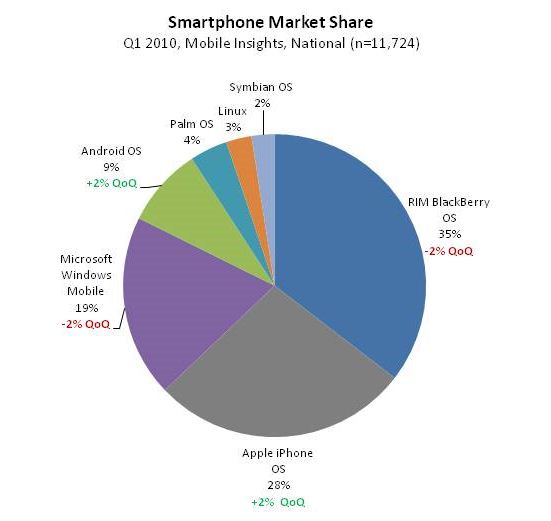 As I have noted here before, this war among Apple, Google, Microsoft, RIM (Blackberry), Palm, Symbian, and others has actually forced me to ask if we have "Too Much Platform Competition" in this arena. App developers must now craft their offerings for so many platforms that it has become a significant developmental hassle and expense. But hey, from a consumer perspective, this is great! (For more details, see Berin's post on "The Fiercely Competitive Mobile OS & Device Markets.") As I have noted here before, this war among Apple, Google, Microsoft, RIM (Blackberry), Palm, Symbian, and others has actually forced me to ask if we have "Too Much Platform Competition" in this arena. App developers must now craft their offerings for so many platforms that it has become a significant developmental hassle and expense. But hey, from a consumer perspective, this is great! (For more details, see Berin's post on "The Fiercely Competitive Mobile OS & Device Markets.")
Regardless, it's still more proof that all the hand-wringing here in Washington about the state of wireless innovation is completely unfounded. It is shocking that we have this many developer platforms in play in the smartphone sector and I am still of the belief that things will eventually shake out to just 3 major OSs. So I don't expect this degree of competition to last. But that's OK, we can still have plenty of competition and innovation with fewer OSs. posted by Adam Thierer @ 9:54 AM |
Antitrust & Competition Policy, Innovation, Wireless
Link to this Entry | Printer-Friendly | Email a Comment |Post a Comment (1)
Wednesday, May 26,
2010
Abolishing the FCC and Other Fun Thoughts
Just the other day, leaders from the House and Senate said they planned on updating the Communications Act. Maybe they've finally started listening to us - we proposed doing this back in 2005, with PFF's Digital Age Communications Act (DACA). Or, perhaps the FCC's so-called "Third Way" doesn't look like the "no-brainer" that the agency spun in its press releases. Well, whatever their intentions may be, it certainly couldn't arrive at a better time.
The framing is all important, of course. Art Brodsky of Public Knowledge (ostensibly one of the groups "writing" the next Act) says Americans shouldn't worry about the FCC's "Third Way." In his view - "The government is not taking over the Internet. What the government is doing is engaging in traditional consumer protection, traditional regulation of a telecommunications service that will get people to the Internet." PK seems happy with this model - whether done at the FCC, or at Congress' hands.
Hmmm...Getting people to the Internet? Traditional, simple stuff. Sort of like strolling to the store, or peddling to the park. Or, like in childhood, making a call from tin cans and string - which is what'll result if PK and their ilk have their way. Continue reading Abolishing the FCC and Other Fun Thoughts . . .
posted by Mike Wendy @ 2:11 PM |
Antitrust & Competition Policy, Broadband, Cable, Communications, DACA, Innovation, Internet, Local Franchising, Mass Media, Media Regulation, Net Neutrality, PFF, Regulation, Spectrum, State Policy, The FCC, The FTC, Universal Service, Wireless
Link to this Entry | Printer-Friendly | Email a Comment |Post a Comment (7)
Sunday, May 23,
2010
Wireless Networks & Lemonade Stand Economics
I've been wading through the FCC's latest Mobile Wireless Competition Report, and articles about it trying to make sense of what the the agency might be up to on this front. It's hard to get a read on where the agency may be going here. As my PFF colleague Mike Wendy suggested in his post on the FCC's report, "far from press reports which state the FCC clearly determined the market is not 'effectively competitive,' well, that's wrong. In fact, the FCC fails to make any such determination whatsoever." Moreover, just flipping through the charts and tables of the 237-page report, one is struck by how dynamic this marketplace is, and how crazy it would be for the FCC to declare it anything other than effectively competitive and highly innovative.
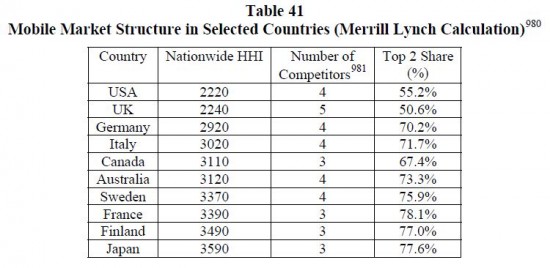
Yet, the FCC and many others seem hung up on industry structure. In particular, there seems to be a lot of hand-wringing about increasing consolidation among the sector's top players. But the data the FCC reproduces in the report seem to undermine that concern. For example, here's a snapshot of the "Mobile Market Structure in Selected Countries," which appears on pg. 197 of the FCC report. It shows how much more consolidated foreign mobile markets are relative to the U.S., which is true of wireline markets too. And you can find much more evidence of how competitive the marketplace is in these two reports.
Continue reading Wireless Networks & Lemonade Stand Economics . . .
posted by Adam Thierer @ 11:39 PM |
Economics, Innovation, Net Neutrality, Wireless
Link to this Entry | Printer-Friendly | Email a Comment |Post a Comment (0)
Thursday, May 20,
2010
FCC Wireless Report Punts - Effective Competition Actually Prevails
As I peruse the FCC's just released Wireless Report, I wanted to jot down some initial thoughts before wading knee-deep in the regulatory morass.
First off - far from press reports which state the FCC clearly determined the market is not "effectively competitive," well, that's wrong. In fact, the FCC fails to make any such determination whatsoever. It says:
...[R]ather than reaching an overarching, industry-wide determination with respect to whether there is "effective competition," the Report complies with the statutory requirement by providing a detailed analysis of the state of competition that seeks to identify areas where market conditions appear to be producing substantial consumer benefits and provides data that can form the basis for inquiries into whether policy levers could produce superior outcomes...
Continue reading FCC Wireless Report Punts - Effective Competition Actually Prevails . . .
posted by Mike Wendy @ 10:25 PM |
Antitrust & Competition Policy, Broadband, Communications, Innovation, Internet, Net Neutrality, Spectrum, The FCC, Wireless
Link to this Entry | Printer-Friendly | Email a Comment |Post a Comment (1)
Wednesday, May 19,
2010
FCC Wireless Report Should Conclude Market Competitive, But Will It?
Rumor has it that that the FCC plans to drop its Wireless Competition Report tomorrow at its monthly meeting. In the past, this report has generally signaled that the market thrives. Tomorrow may tell a slightly different story, however. There is some belief that the Commission may come back on its past report cards, concluding - somehow - that the wireless marketplace is shy of "effective competition," though not uncompetitive.
Some in the telecom community believe that the FCC may be attempting to build a record to justify a more expansive regulatory push for wireless broadband competition. Stranger theories have been heard. The FCC's on a tear of late, trying to perfect broadband markets so that consumers get..well, the thriving market they already have. This could be another such exercise. Continue reading FCC Wireless Report Should Conclude Market Competitive, But Will It? . . .
posted by Mike Wendy @ 3:58 PM |
Broadband, Communications, Innovation, Net Neutrality, The FCC, Wireless, Wireline
Link to this Entry | Printer-Friendly | Email a Comment |Post a Comment (0)
Friday, May 14,
2010
Google, Nexus One, Subsidized Handsets & Consumer Choices
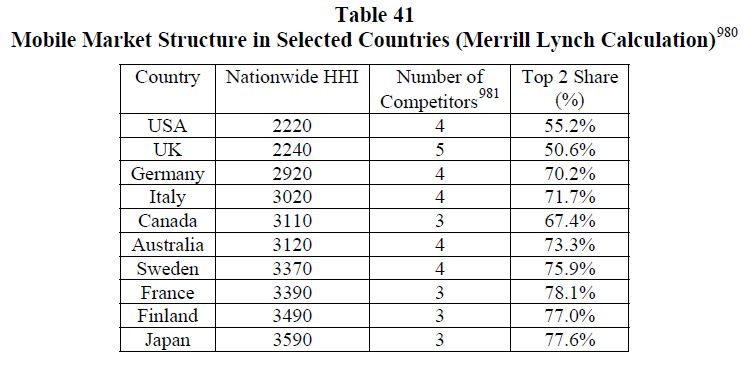
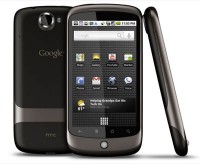 Google has just announced that it is ending web-only sales of its unsubsidized Nexus One smartphone. The company had hoped to created a very different kind of business model for mobile phone retailing, but it just didn't work and so they are ending the experiment. Google has just announced that it is ending web-only sales of its unsubsidized Nexus One smartphone. The company had hoped to created a very different kind of business model for mobile phone retailing, but it just didn't work and so they are ending the experiment.
There are a couple of reasons that it probably didn't work, but the one thing that just about everyone is pointing back to is the difficulty of acclimating Americans to the actual cost of an unsubsidized handset. Over at Ars Technica, Peter Bright points out:
A one-off payment of $529 is hard to stomach. In many countries, we're not accustomed to paying so much for mobile phones, as normally their true cost is hidden--we pay less up front and commit to paying a monthly fee for 12-24 months. Only those brave souls who were willing to stump up for the early termination fee would get any idea of the true cost of their handset. In a world of subsidized handsets, then, the Nexus one felt very expensive. It's true that SIM-only contracts are cheaper than with-handset ones, but the difference rarely feels significant enough to justify buying a full-price phone--much better to pay a little bit more each month and avoid the up-front cost. Even if you do the math and work out that the Google way is cheaper, there's still the unpleasant prospect of spending so much at once.
And Kevin C. Tofel of GigaOm concludes: Continue reading Google, Nexus One, Subsidized Handsets & Consumer Choices . . .
posted by Adam Thierer @ 6:35 PM |
Economics, Wireless
Link to this Entry | Printer-Friendly | Email a Comment |Post a Comment (2)
Monday, April 26,
2010
PFF LTE in NY Times - Let's Not Regulate the Internet
PFF was fortunate enough to get a letter-to-the-editor published in the NY Times this weekend, responding to the paper's call for broad Net Neutrality rules which would regulate broadband services.
Regulate the Internet?
To the Editor:
In "The F.C.C. and the Internet" (editorial, April 19), you ignore two important facts to arrive at your sweeping conclusion that the Federal Communications Commission must regulate the Internet to ensure its health and growth. Continue reading PFF LTE in NY Times - Let's Not Regulate the Internet . . .
posted by Mike Wendy @ 1:00 PM |
Broadband, Cable, Capitol Hill, Communications, Internet, Net Neutrality, PFF, Regulation, The FCC, Wireless, Wireline
Link to this Entry | Printer-Friendly | Email a Comment |Post a Comment (1)
Sunday, March 28,
2010
Free Press & Public Knowledge Try to Invent Regulatory Crisis over Sprint Short Codes
posted by Adam Thierer @ 12:37 PM |
Communications, Generic Rant, Wireless
Link to this Entry | Printer-Friendly | Email a Comment |Post a Comment (1)
Monday, February 22,
2010
CTIA's Refutation of Tim Wu's 2007 Wireless Net Neutrality Paper
posted by Adam Thierer @ 11:04 PM |
Economics, Net Neutrality, Wireless
Link to this Entry | Printer-Friendly | Email a Comment |Post a Comment (3)
Wednesday, December 2,
2009
Let's Make a Deal: Broadcasters, Mobile Broadband, and a Market in Spectrum
posted by Amy Smorodin @ 2:44 PM |
Broadband, Communications, Mass Media, Spectrum, Wireless
Link to this Entry | Printer-Friendly | Email a Comment |Post a Comment (1)
Thursday, November 12,
2009
Oh Farts! The Droid, the iPhone & the Lessig-Zittrain Thesis
posted by Adam Thierer @ 6:15 PM |
Commons, Innovation, Internet, What We're Reading, Wireless
Link to this Entry | Printer-Friendly | Email a Comment |Post a Comment (2)
Friday, October 30,
2009
Financing Wireless Broadband
posted by Amy Smorodin @ 12:15 PM |
Broadband, State Policy, Universal Service, Wireless
Link to this Entry | Printer-Friendly | Email a Comment |
Tuesday, October 20,
2009
Intel "Holiday Mobile Etiquette" Poll
posted by Adam Thierer @ 10:46 PM |
Generic Rant, Wireless
Link to this Entry | Printer-Friendly | Email a Comment |
Saturday, October 17,
2009
Wal-Mart, Cell Phones & Mobile Marketplace Pricing Competition
posted by Adam Thierer @ 11:28 AM |
Wireless
Link to this Entry | Printer-Friendly | Email a Comment |
Sunday, October 11,
2009
Wireless Innovation is Alive & Well: Two New Reports Set the Record Straight
posted by Adam Thierer @ 5:03 PM |
Innovation, Wireless
Link to this Entry | Printer-Friendly | Email a Comment |
Wednesday, October 7,
2009
4.1 Billion Mobile Text Messeges & 6.4 Billion Minutes of Use Per Day
posted by Adam Thierer @ 10:25 PM |
Wireless
Link to this Entry | Printer-Friendly | Email a Comment |
Why Congestion Pricing for the iPhone & Broadband Makes Sense
posted by Adam Thierer @ 9:02 PM |
Economics, Net Neutrality, Spectrum, Wireless
Link to this Entry | Printer-Friendly | Email a Comment |
Sunday, September 27,
2009
Is Apple's iPhone the End of Innovation? Hahn & Singer on Handset Exclusivity Fears
posted by Adam Thierer @ 2:29 PM |
Innovation, Net Neutrality, Spectrum, Wireless
Link to this Entry | Printer-Friendly | Email a Comment |
Thursday, September 24,
2009
Economic Value of Unlicensed Spectrum
posted by Adam Thierer @ 8:56 PM |
Commons, Spectrum, Wireless
Link to this Entry | Printer-Friendly | Email a Comment |
Tuesday, September 22,
2009
The Day Real Internet Freedom Died: Our Forbes Op-Ed on Net Neutrality Regulation
posted by Adam Thierer @ 2:52 PM |
Broadband, Net Neutrality, Philosophy / Cyber-Libertarianism, Wireless
Link to this Entry | Printer-Friendly | Email a Comment |
Thursday, August 6,
2009
Slate's Manjoo on Apple iPhone Regulation
posted by Adam Thierer @ 3:05 PM |
Antitrust & Competition Policy, Net Neutrality, The FCC, Wireless
Link to this Entry | Printer-Friendly | Email a Comment |
Monday, August 3,
2009
Google & Apple: In Collusion or Cut-Throat Competition?
posted by Berin Szoka @ 11:17 AM |
Antitrust & Competition Policy, Broadband, Wireless
Link to this Entry | Printer-Friendly | Email a Comment |
Thursday, June 18,
2009
iPhone Envy
posted by Barbara Esbin @ 3:15 PM |
Capitol Hill, Communications, Wireless
Link to this Entry | Printer-Friendly | Email a Comment |
Thursday, February 26,
2009
Obama Wants to Tax Your Cell Phone
posted by Adam Thierer @ 6:27 PM |
Spectrum, Taxes, Wireless
Link to this Entry | Printer-Friendly | Email a Comment |
Saturday, January 17,
2009
Mobile OS Platforms, Competition, & Generativity
posted by Adam Thierer @ 5:02 PM |
Economics, Innovation, Wireless
Link to this Entry | Printer-Friendly | Email a Comment |
Friday, January 16,
2009
Cellular Socialism
posted by Berin Szoka @ 11:26 PM |
Communications, Universal Service, Wireless
Link to this Entry | Printer-Friendly | Email a Comment |
Monday, October 27,
2008
Exactly Backwards
posted by Barbara Esbin @ 4:55 PM |
Broadband, The FCC, Wireless
Link to this Entry | Printer-Friendly | Email a Comment |
Wednesday, October 1,
2008
Self Help: The Right Approach to Handset Exclusivity
posted by Barbara Esbin @ 2:18 PM |
Broadband, Wireless
Link to this Entry | Printer-Friendly | Email a Comment |
Sunday, September 28,
2008
The Great 'Open v. Closed' Debate Continues: Google Phone v. Apple iPhone
posted by Adam Thierer @ 11:06 AM |
Economics, Generic Rant, Innovation, Interoperability, Wireless
Link to this Entry | Printer-Friendly | Email a Comment |
Saturday, August 9,
2008
Another muni wi-fi failure (Portland), and taxpayers will pick up the tab
posted by Adam Thierer @ 4:40 PM |
Commons, Municipal Ownership, Wireless
Link to this Entry | Printer-Friendly | Email a Comment |
Saturday, July 12,
2008
The Next Great Technopanic: Wireless Geo-Location / Social Mapping
posted by Adam Thierer @ 5:46 PM |
Free Speech, Online Safety & Parental Controls, Wireless
Link to this Entry | Printer-Friendly | Email a Comment |
Saturday, June 28,
2008
Another muni wi-fi failure (Oakland Wireless)
posted by Adam Thierer @ 6:03 PM |
Municipal Ownership, Wireless
Link to this Entry | Printer-Friendly | Email a Comment |
Wednesday, June 25,
2008
Not One, Not Two, but THREE Competing Open Source Mobile Operating Systems
posted by Berin Szoka @ 5:56 PM |
Communications, Software, Wireless
Link to this Entry | Printer-Friendly | Email a Comment |
Wednesday, June 11,
2008
Pay Me Now Or Pay Me Later
posted by W. Kenneth Ferree @ 2:28 PM |
Communications, Wireless
Link to this Entry | Printer-Friendly | Email a Comment |
Tuesday, June 10,
2008
Exclusive Handset Prohibitions: Should the FCC Kill the Goose that Laid the Golden iPhone?
posted by Berin Szoka @ 2:31 PM |
Wireless
Link to this Entry | Printer-Friendly | Email a Comment |
Wireless Boom
posted by Bret Swanson @ 10:50 AM |
Wireless
Link to this Entry | Printer-Friendly | Email a Comment |
Tuesday, February 19,
2008
Markey's Mobile Menace
posted by Bret Swanson @ 2:41 PM |
Wireless
Link to this Entry | Printer-Friendly | Email a Comment |
Thursday, January 10,
2008
All-in and Unlucky
posted by Grant Eskelsen @ 4:14 PM |
Communications, Spectrum, Wireless
Link to this Entry | Printer-Friendly | Email a Comment |
Monday, November 19,
2007
what EarthLink’s muni wi-fi announcement tells us
posted by Adam Thierer @ 1:48 PM |
Municipal Ownership, Wireless
Link to this Entry | Printer-Friendly | Email a Comment |
Monday, August 27,
2007
Mobile Markets: US v. Europe
posted by Adam Thierer @ 11:21 AM |
Wireless
Link to this Entry | Printer-Friendly | Email a Comment |
Tuesday, August 7,
2007
Problems in (muni wi-fi) paradise
posted by Adam Thierer @ 9:57 AM |
Commons, Communications, Municipal Ownership, Wireless
Link to this Entry | Printer-Friendly | Email a Comment |
Monday, July 16,
2007
Mobile Market Snapshot: U.S. v. Europe
posted by Adam Thierer @ 10:29 PM |
Wireless
Link to this Entry | Printer-Friendly | Email a Comment |
Wednesday, June 27,
2007
The 700 MHz Auction--Uh Oh.
posted by Solveig Singleton @ 12:00 PM |
Commons, Communications, Spectrum, Wireless
Link to this Entry | Printer-Friendly | Email a Comment |
Wednesday, May 2,
2007
New reports on Skype-Wu wireless Net Neutrality proposal
posted by Adam Thierer @ 1:34 PM |
Net Neutrality, Wireless
Link to this Entry | Printer-Friendly | Email a Comment |
Tuesday, April 10,
2007
Good Slogans, Bad Policies: Open Access Regulations
posted by Scott Wallsten @ 10:55 AM |
Broadband, Communications, Net Neutrality, Spectrum, Wireless, Wireline
Link to this Entry | Printer-Friendly | Email a Comment |
Friday, April 6,
2007
Frontline, Reed Hundt and Net Neutrality
posted by Jeff Eisenach @ 10:37 AM |
Communications, Net Neutrality, Spectrum, Wireless
Link to this Entry | Printer-Friendly | Email a Comment |
Saturday, February 24,
2007
Wu, Skype, Walled Gardens and "Openness"
posted by Adam Thierer @ 10:31 AM |
Net Neutrality, Wireless
Link to this Entry | Printer-Friendly | Email a Comment |
Thursday, February 22,
2007
Additional Concerns with the Skype-Wu Proposal
posted by Adam Thierer @ 11:38 AM |
Net Neutrality, Wireless
Link to this Entry | Printer-Friendly | Email a Comment |
Tuesday, February 20,
2007
Skype Asks FCC to Impose Carterfone Regs on Wireless
posted by Adam Thierer @ 11:54 PM |
Interoperability, Net Neutrality, Wireless
Link to this Entry | Printer-Friendly | Email a Comment |
Brito Deconstructs Spectrum Commons Theory
posted by Adam Thierer @ 10:50 AM |
Commons, Spectrum, Wireless
Link to this Entry | Printer-Friendly | Email a Comment |
Monday, February 19,
2007
XM + Sirius = Good Deal (for the Companies and Consumers)
posted by Adam Thierer @ 5:21 PM |
Mass Media, Wireless
Link to this Entry | Printer-Friendly | Email a Comment |
Sunday, February 11,
2007
Wireless Net Neutrality?
posted by Scott Wallsten @ 3:29 PM |
Broadband, Spectrum, Wireless
Link to this Entry | Printer-Friendly | Email a Comment |
Wednesday, August 9,
2006
WSJ on the Broadband Market
posted by Patrick Ross @ 2:17 PM |
Broadband, Communications, Net Neutrality, Spectrum, Wireless
Link to this Entry | Printer-Friendly | Email a Comment |
Wednesday, May 31,
2006
Competition Works: An Analysis of Competing Cable-Telco "Triple-Play" Packages
posted by Adam Thierer @ 11:19 PM |
Broadband, Communications, Innovation, Mass Media, Wireless, Wireline
Link to this Entry | Printer-Friendly | Email a Comment |Post a Comment (0)
Thursday, April 27,
2006
Net Neutrality: Remembering the Little Ones
posted by Kyle Dixon @ 8:32 PM |
Broadband, Cable, Communications, DACA, Innovation, Internet, Net Neutrality, VoIP, Wireless, Wireline
Link to this Entry | Printer-Friendly | Email a Comment |
Cellular Content Controls
posted by Adam Thierer @ 2:41 PM |
Free Speech, Wireless
Link to this Entry | Printer-Friendly | Email a Comment |Post a Comment (0)
Thursday, April 13,
2006
Progress in the Debate on Local Telecom Reform?
posted by Kyle Dixon @ 2:24 PM |
Broadband, Capitol Hill, Communications, DACA, General, Internet, Municipal Ownership, State Policy, Wireless, Wireline
Link to this Entry | Printer-Friendly | Email a Comment |Post a Comment (0)
Thursday, April 6,
2006
New Neutrality Proposals: Ask Me No Questions, Tell Me No . . .
posted by Kyle Dixon @ 6:54 PM |
Broadband, Cable, Capitol Hill, Communications, Innovation, Internet, Net Neutrality, The FCC, VoIP, Wireless, Wireline
Link to this Entry | Printer-Friendly | Email a Comment |Post a Comment (0)
Thursday, March 30,
2006
Adjudicating Network Neutrality: Upsides, Downsides and Practical Implications
posted by Kyle Dixon @ 11:47 PM |
Antitrust & Competition Policy, Broadband, Cable, Capitol Hill, Communications, DACA, Innovation, Internet, Net Neutrality, The FCC, VoIP, Wireless, Wireline
Link to this Entry | Printer-Friendly | Email a Comment |Post a Comment (0)
Thursday, March 23,
2006
Who's Afraid of the Big Bad Bundle?
posted by Kyle Dixon @ 11:16 PM |
Broadband, Cable, Communications, Innovation, Internet, Net Neutrality, VoIP, Wireless, Wireline
Link to this Entry | Printer-Friendly | Email a Comment |Post a Comment (0)
Thursday, March 16,
2006
Wireless Piggybacking
posted by Adam Thierer @ 2:16 PM |
Broadband, Communications, Innovation, Wireless
Link to this Entry | Printer-Friendly | Email a Comment |Post a Comment (0)
Tuesday, March 14,
2006
'Propertization' of Spectrum on the Hill
posted by Patrick Ross @ 2:48 PM |
DACA, Spectrum, Wireless
Link to this Entry | Printer-Friendly | Email a Comment |Post a Comment (0)
Monday, March 6,
2006
Possible Conditions on the AT&T-Bell South Deal
posted by Adam Thierer @ 10:57 AM |
Antitrust & Competition Policy, Communications, Net Neutrality, Wireless, Wireline
Link to this Entry | Printer-Friendly | Email a Comment |Post a Comment (0)
Friday, February 17,
2006
Worms in the Apple?
posted by Kyle Dixon @ 1:02 PM |
Broadband, Cable, Capitol Hill, Communications, DACA, Innovation, Internet, Net Neutrality, VoIP, Wireless, Wireline
Link to this Entry | Printer-Friendly | Email a Comment |Post a Comment (0)
Wednesday, February 1,
2006
Technology and Sports
posted by Patrick Ross @ 4:22 PM |
Wireless
Link to this Entry | Printer-Friendly | Email a Comment |Post a Comment (0)
Friday, January 20,
2006
Theoretically Speaking: Trinko and Broadband
posted by Kyle Dixon @ 12:19 AM |
Antitrust & Competition Policy, Broadband, Cable, Communications, Innovation, Internet, Net Neutrality, Supreme Court, The FCC, Wireless, Wireline
Link to this Entry | Printer-Friendly | Email a Comment |Post a Comment (0)
Friday, November 18,
2005
In Search of Appropriate Social Goals in Communications Regulation
posted by Kyle Dixon @ 1:12 AM |
Broadband, Cable, Capitol Hill, Communications, Free Speech, Innovation, Internet, Mass Media, The FCC, Universal Service, VoIP, Wireless, Wireline
Link to this Entry | Printer-Friendly | Email a Comment |Post a Comment (0)
Thursday, November 3,
2005
A Silver Lining to Net Neutrality Merger Conditions?
posted by Kyle Dixon @ 4:02 PM |
Broadband, Cable, Capitol Hill, Communications, Innovation, Internet, Net Neutrality, The FCC, VoIP, Wireless, Wireline
Link to this Entry | Printer-Friendly | Email a Comment |Post a Comment (0)
Wednesday, October 26,
2005
Our Coming Wireless World
posted by Adam Thierer @ 10:53 AM |
Wireless
Link to this Entry | Printer-Friendly | Email a Comment |Post a Comment (0)
Friday, October 14,
2005
Crossing Thresholds: Questioning the Ends and Means of Social Regulation in Communications
posted by Kyle Dixon @ 8:38 PM |
Broadband, Cable, Capitol Hill, Communications, General, Innovation, Internet, Mass Media, Net Neutrality, The FCC, Universal Service, VoIP, Wireless, Wireline
Link to this Entry | Printer-Friendly | Email a Comment |Post a Comment (0)
Wednesday, October 5,
2005
Google, Do You Really Want to Be a Telecom Company?
posted by Adam Thierer @ 4:37 PM |
Broadband, Capitol Hill, Communications, Mass Media, Municipal Ownership, Net Neutrality, Wireless
Link to this Entry | Printer-Friendly | Email a Comment |Post a Comment (0)
Wi-Fi (and maybe more) For Everyone!
posted by Mike Pickford @ 3:36 PM |
Wireless
Link to this Entry | Printer-Friendly | Email a Comment |Post a Comment (0)
Tuesday, October 4,
2005
Competition Policy Begets Tax Policy
posted by @ 9:57 AM |
Economics, Internet, State Policy, Wireless
Link to this Entry | Printer-Friendly | Email a Comment |Post a Comment (0)
Friday, September 16,
2005
Wi-Fi Brite in Ohio
posted by @ 4:01 PM |
Internet, Municipal Ownership, Wireless
Link to this Entry | Printer-Friendly | Email a Comment |Post a Comment (0)
Thursday, September 15,
2005
Looks Like They Were Right
posted by Patrick Ross @ 2:33 PM |
Broadband, Communications, Municipal Ownership, Wireless
Link to this Entry | Printer-Friendly | Email a Comment |Post a Comment (0)
Thursday, September 8,
2005
Public Safety Tradeoffs Post-Katrina
posted by Kyle Dixon @ 5:37 PM |
Broadband, Capitol Hill, Communications, Internet, Interoperability, The FCC, VoIP, Wireless, Wireline
Link to this Entry | Printer-Friendly | Email a Comment |Post a Comment (0)
Friday, August 19,
2005
The FCC and Organization Development
posted by Kyle Dixon @ 10:17 AM |
Broadband, Cable, Capitol Hill, Communications, Innovation, Internet, Mass Media, Spectrum, The FCC, VoIP, Wireless, Wireline
Link to this Entry | Printer-Friendly | Email a Comment |Post a Comment (0)
Thursday, August 11,
2005
Downsides to Deregulating Broadband??
posted by Kyle Dixon @ 7:00 PM |
Broadband, Cable, Communications, Innovation, Internet, Mass Media, Supreme Court, The FCC, Wireless, Wireline
Link to this Entry | Printer-Friendly | Email a Comment |Post a Comment (0)
Friday, July 15,
2005
Cell Phones on Planes: A Federal Matter?
posted by Adam Thierer @ 9:56 AM |
Wireless
Link to this Entry | Printer-Friendly | Email a Comment |Post a Comment (0)
Friday, June 24,
2005
Know Your WPAN from Your WWAN?
posted by @ 4:15 PM |
Wireless
Link to this Entry | Printer-Friendly | Email a Comment |Post a Comment (0)
Wednesday, June 15,
2005
Local Revenue Story: An Additional $3 a Month for Wireless in Alexandria
posted by @ 2:42 PM |
Wireless
Link to this Entry | Printer-Friendly | Email a Comment |Post a Comment (0)
Tuesday, June 14,
2005
Assessing Liability? Trespass on (Municipal) Wi-Fi Networks
posted by @ 11:09 AM |
Municipal Ownership, State Policy, Wireless
Link to this Entry | Printer-Friendly | Email a Comment |Post a Comment (0)
Friday, June 10,
2005
Spectrum Reform: The UK Perspective in Guatemala
posted by Tom Lenard @ 7:44 PM |
Communications, Spectrum, Wireless
Link to this Entry | Printer-Friendly | Email a Comment |Post a Comment (0)
Thursday, June 9,
2005
Spectrum Reform in Guatemala
posted by Tom Lenard @ 11:42 PM |
Communications, Spectrum, Wireless
Link to this Entry | Printer-Friendly | Email a Comment |Post a Comment (0)
Tuesday, June 7,
2005
Arbitrage Be Thy Name
posted by @ 5:12 PM |
Wireless
Link to this Entry | Printer-Friendly | Email a Comment |Post a Comment (0)
Friday, May 27,
2005
Reality Check for Muni Wi Fi
posted by @ 3:03 PM |
Broadband, Municipal Ownership, Wireless
Link to this Entry | Printer-Friendly | Email a Comment |Post a Comment (0)
Monday, May 23,
2005
Ugh!
posted by Ray Gifford @ 7:20 PM |
Communications, Wireless, Wireline
Link to this Entry | Printer-Friendly | Email a Comment |Post a Comment (0)
DTV and Wireless Broadband: Come Now, Folks . .
posted by Kyle Dixon @ 5:10 PM |
Broadband, Capitol Hill, Communications, Digital TV, Spectrum, Wireless
Link to this Entry | Printer-Friendly | Email a Comment |Post a Comment (0)
Wednesday, May 11,
2005
Mobile Phone Service is Getting Hit with Heavy Taxes
posted by @ 1:23 PM |
State Policy, Wireless
Link to this Entry | Printer-Friendly | Email a Comment |Post a Comment (0)
Sunday, May 8,
2005
The Art of the DTV Deal: Continued
posted by Ray Gifford @ 5:15 PM |
Broadband, Capitol Hill, Digital TV, Spectrum, The FCC, Wireless
Link to this Entry | Printer-Friendly | Email a Comment |Post a Comment (0)
Wednesday, April 27,
2005
DTV: The Art of the Deal
posted by Ray Gifford @ 4:57 PM |
Digital TV, Wireless
Link to this Entry | Printer-Friendly | Email a Comment |Post a Comment (0)
Free the DTV Spectrum!
posted by Patrick Ross @ 3:23 PM |
Digital TV, Wireless
Link to this Entry | Printer-Friendly | Email a Comment |Post a Comment (0)
Monday, April 25,
2005
Will A Wireless Ratings Scheme Be Enough to Head Off Cellphone Censorship?
posted by Adam Thierer @ 9:44 AM |
Free Speech, Wireless
Link to this Entry | Printer-Friendly | Email a Comment |Post a Comment (0)
Wednesday, April 20,
2005
More on Cellphone TV Regulation
posted by Adam Thierer @ 10:45 AM |
Free Speech, Mass Media, Wireless
Link to this Entry | Printer-Friendly | Email a Comment |Post a Comment (0)
Thursday, March 24,
2005
Texas E-911
posted by Randolph May @ 11:49 AM |
Wireless
Link to this Entry | Printer-Friendly | Email a Comment |Post a Comment (0)
Thursday, March 17,
2005
Red Lion R.I.P.: FCC Declares the Scarcity Doctrine Dead
posted by Adam Thierer @ 6:05 PM |
Free Speech, Mass Media, Wireless
Link to this Entry | Printer-Friendly | Email a Comment |Post a Comment (0)
Monday, February 28,
2005
New Meaning to "High-Speed"
posted by Patrick Ross @ 2:46 PM |
Wireless
Link to this Entry | Printer-Friendly | Email a Comment |Post a Comment (0)
Tuesday, February 1,
2005
Which is bigger?
posted by Ray Gifford @ 7:17 PM |
Communications, Wireless
Link to this Entry | Printer-Friendly | Email a Comment |Post a Comment (0)
Digital Age Communications Act
posted by Ray Gifford @ 1:31 PM |
Broadband, Capitol Hill, Communications, The FCC, Wireless
Link to this Entry | Printer-Friendly | Email a Comment |Post a Comment (0)
Monday, January 31,
2005
Listen to Humpty Dumpty
posted by Randolph May @ 9:52 AM |
Antitrust & Competition Policy, Communications, Wireless
Link to this Entry | Printer-Friendly | Email a Comment |Post a Comment (0)
Thursday, January 27,
2005
A Rare Event
posted by Tom Lenard @ 4:32 PM |
Wireless
Link to this Entry | Printer-Friendly | Email a Comment |Post a Comment (0)
Kicking it Down the Road...or Kicking it to the Curb?
posted by @ 4:29 PM |
Wireless
Link to this Entry | Printer-Friendly | Email a Comment |Post a Comment (0)
Thursday, January 6,
2005
Power Struggle...
posted by @ 4:54 PM |
State Policy, Wireless
Link to this Entry | Printer-Friendly | Email a Comment |Post a Comment (0)
Thursday, December 9,
2004
Sprint & Nextel...
posted by Ray Gifford @ 5:49 PM |
Wireless
Link to this Entry | Printer-Friendly | Email a Comment |Post a Comment (0)
Tuesday, December 7,
2004
VoIP Goes Mobile
posted by Patrick Ross @ 10:10 AM |
VoIP, Wireless
Link to this Entry | Printer-Friendly | Email a Comment |Post a Comment (0)
Friday, November 5,
2004
The End of the NextWave Saga
posted by @ 8:04 PM |
Wireless
Link to this Entry | Printer-Friendly | Email a Comment |Post a Comment (0)
Monday, October 18,
2004
The Middlemen Win
posted by @ 9:35 PM |
The FCC, Wireless
Link to this Entry | Printer-Friendly | Email a Comment |Post a Comment (0)
|