I've long known and liked Danny Weitzner, going way back to the CDA wars of the mid-1990s. Danny co-founded the Center for Democracy & Technology, which is were I first met him, and he currently serves as Co-Director of MIT's Decentralized Information Group, which is part of the computer science department up there. Apparently he is also now serving as technology adviser to the Barack Obama campaign. In it is that capacity he made some remarks recently on a panel at the Computers, Freedom, and Privacy conference that caught my eye. Specifically, according to this Ars article:
"Openness is more important than bandwidth," said Weitzner, referring to the argument that "tiered" networks providing faster access to content providers who can pay could spur investment in fatter pipes. "I'd rather have a more open Internet at lower speeds than a faster Internet that has all sorts of discrimination built in. We've lived with tiny narrow little pipes and done extraordinary things with them."
I'm a bit troubled by Danny's statements. First, I think that many supporters of Net neutrality (NN) regulation have been crafting this sort of false choice between openness and bandwidth. I see no reason why we can't have plenty of openness as bandwidth grows. After all, it is openness to new services and applications that will help spur greater demand for bandwidth. Of course, I don't buy into the sort of conspiratorial theories set forth by some NN advocates who claim that broadband providers are going to engage in all sorts of blocking of online speech and applications. If you subscribe to certain 'black helicopter' theories of ISP manipulation of the Net, however, then I suppose you would be inclined to say we might somehow be better off with "tiny narrow little pipes" (a la dial-up connections) instead of high-speed pipes. But, again, I just don't buy the argument that ISPs are out to quash "openness" in that sense. Assuming they could even succeed in such an endeavor, which is highly dubious, it's just not good for business. It would create a huge consumer backlash, a PR hell, and ultimately not bring in any new revenue.
This morning in New York the Internet Innovation Alliance hosted two discussions on the Exaflood. Here's video of the first discussion in which I took part, along with Paul Mankiewich, CTO of Alcatel-Lucent; Prof. Andy Odlyzko of the University of Minnesota; and Nick Rockwell, CTO of MTV Networks.
On the second panel were Ciena CEO Gary Smith; Johna Till Johnson of Nemertes Research; Michael Kleeman of UC San Diego; and Craig Moffett of Sanford Bernstein.
Here's another Exaflood-related video I just found. It's of a Telecom TV interview I did in Paris in late February.
It's long been clear that America's 40-year embargo on trade with Cuba has been an abject failure. It didn't lead to an ouster of the Castro regime and has probably hurt the Cuban people much more than it has helped. As my old Cato colleague Dan Griswold put it:
Economic sanctions rarely work. Trade and investment sanctions against Burma, Iran, and North Korea have failed to change the behavior of any of those oppressive regimes; sanctions have only deepened the deprivation of the very people we are trying to help.
And there is no better example of how we are hurting the very people we are trying to help than when we place embargoes on communications technologies. I bring this up because you may have heard that President Bush just announced that the embargo will be modified "to allow Americans to send mobile phones to family members in Cuba." The White House press release also noted that. "President Bush repeated his offer to license U.S. non-governmental organizations (NGOs) and faith-based groups to provide computers and internet to the Cuban people – if Cuban rulers will end their restrictions on Internet access." And, Dan Fisk, NSC Senior Director for Western Hemisphere Affairs, also noted at a White House press briefing on the subject: "if Cubans can own cell-phones or mobile phones, then they should be allowed to freely and publicly express themselves. If Cubans can own computers, then it would seem that they should be allowed to have unfettered access to the Internet."
My question is: What took our government so long to realize this? This was all just as true 10 years ago as it is today. In my opinion, if we really wanted to be encouraging regime change in Cuba, our government should have been boxing up cell phones, PCs and other digital gadgets long ago and dropping them on Cuba's shores! These are technologies of freedom, after all. They can empower the masses and help them organize dissent and express their opposition to the statist thugs in the ruling regime.
And why is the White House only allowing family members to send over phones, or limiting the offer of PC shipments to just NGOs or faith-based groups? We ought to let anybody who wants to donate communications and computing devices ship whatever they have over. Hell, this might me our solution to the e-waste problem in America! Just send all those old gadgets to Cuba! I'm sure the Cuban people would love to have them, and I would love to see what they might do with them if they were digitally empowered in this fashion. How sad that our government only grants selective permission for it to happen.
Of course, God only knows how they will go about getting any service on those phones or PCs in such a repressed land. Perhaps we can set up cell towers and WiMax nodes on boats circling the island 24/7!
A key to American competitiveness and growth over the centuries has been our friendly treatment of capital and labor. Relative to the world, we've mostly imposed lower tax rates on income and investment and reaped the rewards in terms of the largest economy -- and the largest tax base and most tax receipts.
Moreover, as we substantially reduced tax rates over the last 50 years, federal tax revenue remained basically constant at around 18.5% of GDP. It's an unambiguous argument for low tax rates, and in an article last fall, I called this phenomenon Reynolds' Law after the economist who first noted it, Alan Reynolds.
But not so fast! Today, David Ranson pens a brief article with a great little chart, highlighting the same phenomenon, but says we should call it Hauser's Law after San Francisco economist Kurt Hauser who noted the relationship in 1993.
No matter. The concept is so simple it has probably been noted by others, too. But as the world becomes more competitive with flat taxes flourishing in the former Communist world and tax cuts fueling global growth, from China and Singapore to Dubai and Ireland, American politicians should look at this simple chart that shows they cannot raise more revenue with higher tax rates -- and then shelve their silly high-tax plans.
Reynolds or Hauser, the revenue relationship remains. A tax-cut by any other name would smell as sweet.
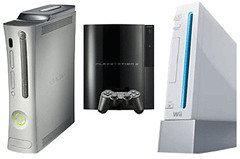
Over at the New York Times Bits blog, Eric Taub is wondering who is winning the (video game) console wars. But the more interesting question is: How is it that we been lucky enough to have sustained, vigorous competition among three major platform developers for so long?
Honestly, I never understood how there was enough room for 3 competing consoles in the video game market. I figured that if consumers didn't do in one of the platforms first that game developers would sink one of them in the name of simplifying development and minimizing costs. In fact, last October, an EA executive called for a "single, open platform" for developers to replace the competing console model. It would be interesting to see how a single platform impacted game development, but I think most of us find real benefits from having competing consoles at our disposal.
For example, I'm lucky enough to own both an XBox 360 and a Sony PS3, and although most of the games I play are available on both, each system has its own advantages and keeps the other one on its toes. Specifically, the Xbox offers an outstanding online marketplace with tons of great downloadable content, including HD movies and more TV shows than I can count. Sony, by contrast, is struggling to catch up to Microsoft's online offerings, but the PS3 is an outstanding media player in its own right. Most electronics and home theater magazines agree that the PS3 is still the best Blu-Ray player on the market today. And, although I don't have a Nintendo Wii, I think we can all appreciate the innovative controller that Nintendo brought to the market and the way it has injected an entirely new element into the home console wars. Finally, I haven't even mentioned the unique advantages that the PC platform offers gamers who are into simulators or more intense online, interactive gameplay than what consoles offer.
In sum, video game console competition is playing out quite nicely, even though I still find it hard to understand how all 3 systems (4 if you include the PC market) continue to co-exist.
Two events of interest to followers of Internet technologies and trends:
First I'll be speaking at an Internet Innovation Alliance event called The Exaflood: Finding Solutions in New York City this Thursday.
Next week we'll move north a few hundred miles to Lake George, NY, for the 12th annual Gilder/Forbes Telecosm conference, also titled "The Exaflood," where I'll be speaking on Internet traffic trends and also on the global economy.
There are a number of big questions facing the country as we approach an election of great consequence this fall. The whiff of "change" is in the air, after all. One of the very biggest questions is whether, in the face of dramatic changes in the global economy, the U.S. will turn towards comfortable security and "equality" or whether it will recommit to the strategy that put us at the top of the world -- entrepreneurial capitalism.
We still have companies and corporations, but now they are virtualized, with online work teams handing off assignments to each other 24/7 around the world. Men and women go to work, but the office is increasingly likely to be in the den. In 2005, an Intel survey of its employees found that nearly 20% of its professionals had never met their boss face-to-face. Half of them never expected to. Last summer, when the Media X institute at Stanford extended that survey to IBM, Sun, HP, Microsoft and Cisco, the percentages turned out to be even greater.
Newspapers are dying, networks are dying, and if teenage boys playing GTA 4 and World of Warcraft have any say about it, so is television. More than 200 million people now belong to just two social networks: MySpace and Facebook. And there are more than 80 million videos on YouTube, all put there by the same individual initiative.
The most compelling statistic of all? Half of all new college graduates now believe that self-employment is more secure than a full-time job. Today, 80% of the colleges and universities in the U.S. now offer courses on entrepreneurship; 60% of Gen Y business owners consider themselves to be serial entrepreneurs, according to Inc. magazine. Tellingly, 18 to 24-year-olds are starting companies at a faster rate than 35 to 44-year-olds. And 70% of today's high schoolers intend to start their own companies, according to a Gallup poll.
An upcoming wave of new workers in our society will never work for an established company if they can help it. To them, having a traditional job is one of the biggest career failures they can imagine.
I agree that the vector of our economy is toward more entrepreneurship. But it is by no means a sure thing that this vector will be sustained. Crucial decisions on free trade, health care, immigration, energy production and usage, Internet regulation, and taxes, among others, will help determine whether entrepreneurs can afford to strike out on their own. Whether the human and financial capital crucial to innovation will continue to flow to the U.S. Whether our sense of risk is tipped toward the ever-brighter future or whether, believing our best days are behind, we decide to draw down on past innovations and accumulated wealth.
Entrepreneurship is always a bit scary. Malone notes that our economy is likely to become even more dynamic. And thus disorienting.
The economy will be much more volatile and much more competitive. In the continuous fervor to create new institutions, it will become increasingly difficult to sustain old ones. New political parties, new social groupings, thousands of new manias and movements and millions of new companies will pop up over the next few decades. Large corporations that don't figure out how to combine permanence with perpetual change will be swept away.
This higher level of anarchy will be exciting, but it will also sometimes be very painful. Entire industries will die almost overnight, laying off thousands, while others will just as suddenly appear, hungry for employees. Continuity and predictability will become the rarest of commodities. And if the entrepreneurial personality honors smart failures, by the same token it has little pity for weakness. That fraction of Americans – 10%, 20% – who still dream of the gold watch or the 30-year pin will suffer the most . . . and unless their needs are somehow met as well, they will remain a perpetually open wound in our society.
This is the trick. The security within our grasp is almost always more appealing than the unknown. For a rich nation like the U.S., this temptation toward known comforts will be even greater than for the poor nation with nothing to lose.
So, as we struggle to keep our bearings in this volatile world of technology and globalization, we should all keep Einstein's simple maxim in mind:
Life is like riding a bicycle. To keep your balance you must keep moving.
The best way to navigate the bumps, curves, and valleys of the global economy is not to stop or slow way down but to keep moving.
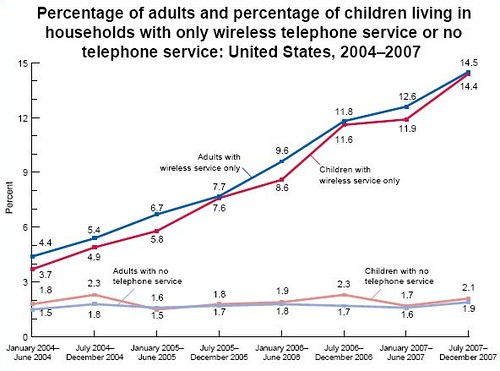
The National Center for Health Statistics, part of the Center for Disease Control, recently released some new data on wireless substitution collected from a survey conducted in the second half of last year. The report notes that:
Preliminary results from the July-December 2007 National Health Interview Survey (NHIS) indicate that nearly one out of every six American homes (15.8%) had only wireless telephones during the second half of 2007. In addition, more than one out of every eight American homes (13.1%) received all or almost all calls on wireless telephones despite having a landline telephone in the home.
I found it interesting how the report broke out that latter group of "wireless-mostly households" since that's the group I'm in. My wife and I keep a landline (1) for emergency purposes, and (2) as the equivalent of a spam line that we can give out to people who demand a phone number but who we never want to talk to again! Anyway, I think these numbers make it clear that, in a few years time, the majority of Americans are likely to be wireless-only or wireless-mostly homes and wireline systems will grow less and less important.
Update: Jason Fry of the Wall Street Journal explores what these numbers mean in his entertaining column today, "The Landline That Refused to Leave." And his colleague Carl Bialik, who pens the always-brilliant "Numbers Guy" column for the Journal also sounded off on this.
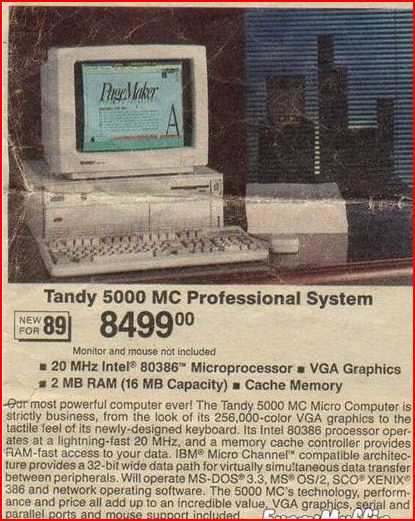
I was just cleaning out some old e-mails and found this old Radio Shack ad that a friend had sent me a couple of years ago. Sadly, I remember lusting after this machine back in 1989. A 20 MHz processor, 2 megs of RAM, and "mouse support included" made this Tandy 5000 professional "the most powerful computer ever." But with a price tag of $8499, it was practically as out of reach as a new Ferrari. (And note the fact that the ad makes clear that "monitor and mouse not included." Can't even imagine what that brought the final total to). And I love the fact that it's running the old Aldus PageMaker program, which I used to think was the greatest thing since sliced bread. God, I can't even imagine using that clunky program now. It's just amazing to think how far we have come in the last 20 years.
We welcome comments by email - look for a link to the author's email address in
the
byline of each post. Please let us know if we may publish your remarks.