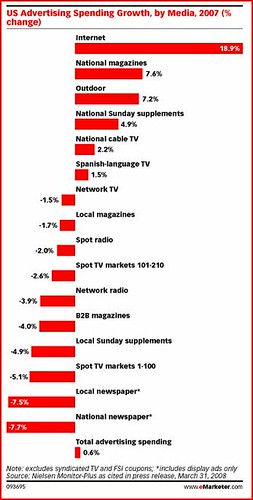
 As we've discussed here before, newspapers are struggling. We all know that. The question is what, if anything, will save them? Most pundits tend to point to a two-fold solution: (1) get serious about leveraging the natural local advantages newspapers hold; (2) and find away to do so online as quickly as possible before they lose the bulk of the local online ad market to other competitors. This is why there's a lot of talk these days about turning traditional papers into "hyper-local" web portals for their communities. Of course, there's no guarantee that will work, especially in light of changing attitudes about "media localism."
But let's assume that that is indeed the best path forward. Will it really save newspapers? As eMarketer reports in today's newsletter on "Can Local Web Ads Save Newspapers," it's a bit of a good news--bad news story:
The good news is that newspaper site ad revenues are growing along with other online ad spending, especially for local news sites. Local newspaper online ad revenues are predicted to reach $3.7 billion this year, according to eMarketer calculations based on Borrell Associates data.
The bad news is that this spending will not make up for print ad losses for some time, according to Lisa Phillips, senior analyst at eMarketer. Ms. Phillips noted that advertisers still pay more for print readers than for online readers. "This is a transition that will take several years," she said. "Local advertisers are paying attention to the shift in reader behavior, but it will take a while for everyone to adjust."
And so we will have to wait to see how it all plays out. But I am highly skeptical that traditional newspapers operators will be able to make up anywhere near the amount of revenue online that they are hemorrhaging over on the print side of the business. There's just too much other competition out there online already for our eyes and ears. The age of "protectable scarcity" is dead and that means newspapers just don't have the lock on local or regional markets they once did.